A testament to how little is written or discussed of the
lifelong emotional impact of watching other people die, even a voracious lay
consumer of psychological and medical research and studies as myself hadn’t
heard the word “survivor’s guilt” used in the context of my mother’s early
childhood until seven years ago. Not a single doctor treating my mother has
ever expressed it, and the countless doctors who treated my maternal
grandparents for a variety of ailments never made any connection. None have
ever seemed to comprehend how and why she’s still so traumatized and often
acts, by the standards of practitioners of Western medicine, erratically,
irrationally or with extreme sensitivity and volatility. As a teenager, my
husband watched as someone very dear to him killed herself. This, to me, is an
unimaginable horror – the stuff of nightmares, the kind I’ve had. It’s
especially challenging for me to articulate empathy in any profound way that
would make my mother understand how passionately I strive to recognize the emotions
she experiences. Sharing such emotions isn’t easy and it may not be healthy.
Those nightmares were chronic in my early childhood and pre-adolescence, and
only began to taper in frequency in my mid-teens. Many would be of what I
imaged as concentration camps or people hovering over mass graves as their
loved ones were piled into pits like compost. Naturally all these images were
based on what my mother and her parents had endured.


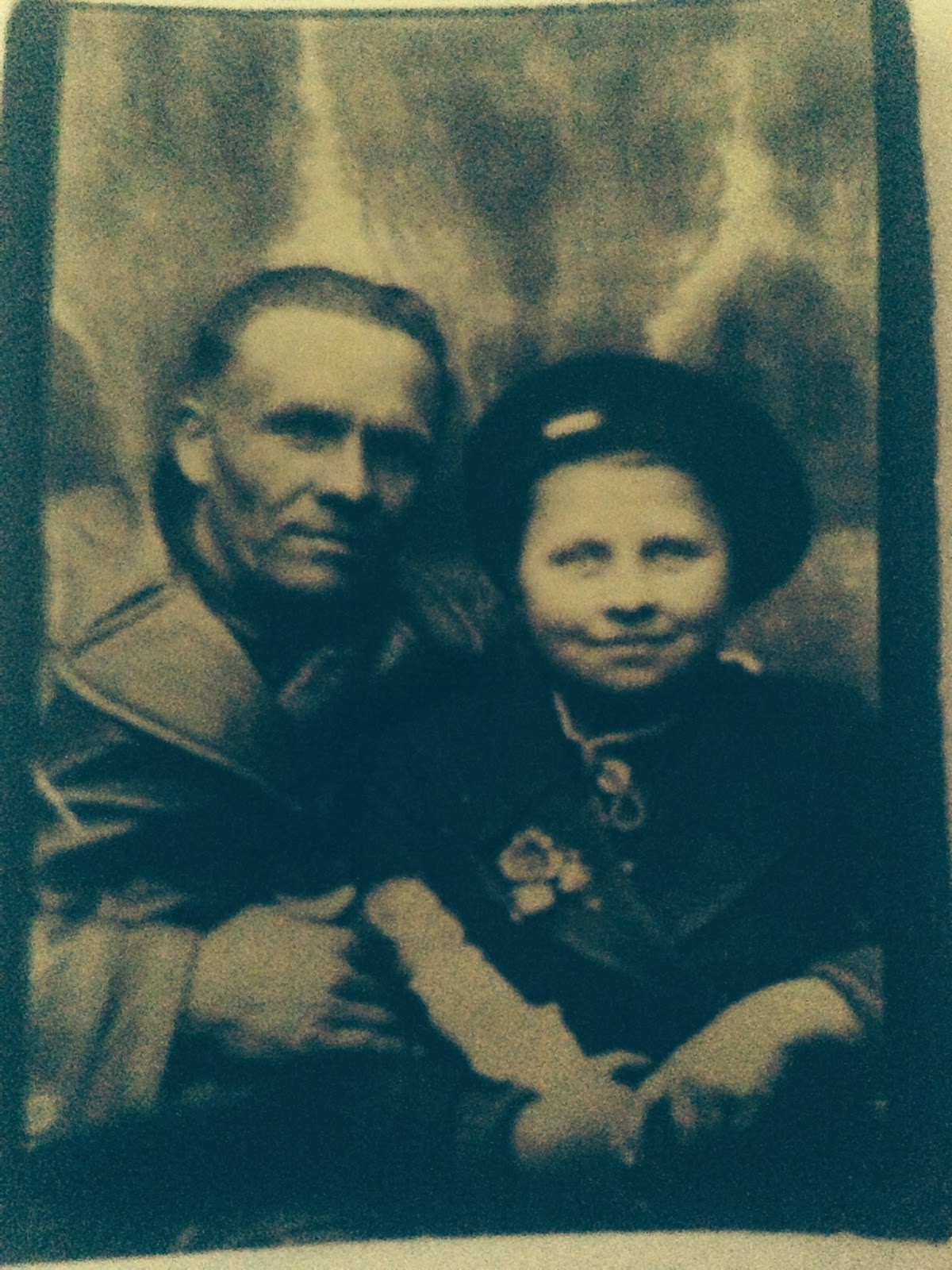
My mother with her mother, 1949. My mother with her
father, 1947. Both photos taken in Hanover, Germany. No photos exist of my mother before the displaced persons camp in Hanover.
Sigmund Freud referred to survivor’s guilt following his
father’s death, in a letter to his friend, otolaryngologist (ear, nose, and
throat doctor) Wilhelm Fliess, referring to “that tendency toward self-reproach
which death invariably leaves among the survivors.
Simply put, it’s the feeling that you have harmed others,
especially loved ones, just because you were spared death when they died. The
term "survivor syndrome" was coined in 1961 by psychoanalyst W.G. Niederland,
who in the 1950s began studying concentration camp survivors.
Among survivors of World War II concentration camps, guilt
is sometimes manifested in strange yet subtle forms, such as behaving as if
they themselves are dead, inhibiting themselves from success or engaging in
self-destructive acts in response to survivor’s guilt in regard to a dead
parent or sibling, A H Modell revealed in a seminal article published in 1971
in The International Journal of Psychoanalysis. I recall one instance when my
grandfather lied down under his car, acting as if he were dead. I was a young
teen. I was horrified. I knew it had something to do with his experiences, and
I felt guilty for lacking the psychological study to identify his condition. (I
have an unsupported theory that survivor’s guilt is passed down to the next
generation more so than other forms of guilt.)
“Survivor's guilt constitutes the failure of the
psychological immune system to grapple with tragedy of great magnitude. Like an
infection that overwhelms the body's immune system, survivor's guilt overwhelms
the psychological immune system. Instead of exaggerating the difference between
oneself and a victim, the similarity is what strikes people as most obvious. ‘That
poor guy was no different from me; it could just as well have been me instead
of him.’ With survivor's guilt, the
differences between oneself and another person shrink, and so too do the
differences between what actually happened and what could have happened. As
with a bad infection, the best recourse is medical treatment,” writes Neal
Roese, Ph.D., in his 2005 book, “If Only: How to Turn Regret Into Opportunity.”
I find this fascinating, as I've often wondered if there was
any correlation between people of my mother’s (and grandparents’) immigration
and a proliferation of autoimmune diseases. I rarely share this premise, as
finding Western medical professionals who even discuss something that’s not
published in a study they read or wrote is generally impossible. In any case, I
know more than most people outside of endocrinology about autoimmune diseases
as it took decades for me to find a doctor to properly diagnose mine. I'd been
confident for years that I had some form of autoimmune hypothyroidism, as my
maternal grandfather suffered from hypothyroidism and my mother had a
thyroidectomy. My grandfather wasn’t diagnosed until it was too late, when he
was hospitalized for what may have been delayed symptoms of a nearly fatal car
crash that he “miraculously” survived, doctors and first responders told me at
the time. (At 15, I was in the ambulance and in the operating room with him.)
My mother’s hypothyroidism also went undiagnosed and untreated for decades. Doctors
blamed my symptoms on anything else, even my own behavior, and refused to send
out blood work for a quick, simple and cheap test of free levels of
triiodothyronine (T3) and thyroxine (T4), which together regulate your body’s
temperature, metabolism and heart rate, because my "TSH (or thyroid
stimulating hormone) is fine." Finally, I found a doctor who’d written an
article on a study that articulated exactly what I’d been telling other
doctors, and he immediately diagnosed me with Hashimoto's thyroiditis, a
genetic disease. My mother’s mother had rheumatoid arthritis, and my sister is
afflicted with RA, along with Lupus and Raynaud's phenomenon (RP) – all
autoimmune diseases. So many people I
knew growing up from the same immigration also suffered from various autoimmune
diseases, while diabetes and heart disease was extremely rare in this
community. These people grew their own vegetables and fruits, fished and only
bought meat if they knew how the animal was slaughtered. This was in the third-largest
city in Massachusetts and fourth-largest in New England. My grandparents kept hens
in a perch of shelves that my grandfather build into a one-car garage, grew
dozens of vegetable varieties and berries, and even kept and slaughtered their
own pigs. I often went fishing (at a nearby lake) and mushroom picking (at a
nearby forest) with my grandfather. I picked berries from the small yard and
helped collect eggs from the hens. My grandfather volunteered as a beekeeper at
the monastery where he’s now buried on his vacations from factory work and brought
home the equipment to keep hives in the yard.
My unexamined autoimmne hypothesis aside, there’s been even
less done to psychologically diagnose these people and treat their obvious
survivor’s guilt and often posttraumatic stress disorder (PTSD). This is an
unforgivable failure of our mental health system and our society at large.
America has welcomed the “wretched refuse of your teeming shore” but it has
done nothing to help those huddled masses heal from the incomparable suffering
of surviving war after war. PTSD and survivor’s guilt is so rarely used in
conversations about anyone but U.S. military veterans. Unarmed civilians suffer
far more than soldiers. PTSD and survivor’s guilt are often confused, even by
trained specialists, but they are very different phenomena. While PTSD is
psychopathological phenomenon, survivor’s guilt is more of an expression of a
normal concern for other human beings, both as individuals and as a society.
My intention is never to undermine the struggle of soldiers.
My father was a decorated veteran who served in the South Pacific and in Korea,
and is immortalized in The New Orleans D-Day Museum. Many men in my family have
served in numerous wars and conflicts. But when they volunteer or they’re
drafted or recruited, soldiers are warned of the trauma to come, even if they
cannot effectively prepare for it. Even the most distressed societies make an
effort, and often a promise, to protect civilians, yet no adult or child ever is
warned of the sudden terror that leads to destruction of what was a civil
society. My mother also was robbed of a childhood, adding another level of
stress to her guilt.
“The various effects that adults who were child survivors
experience can be attributed to many aspects of their traumatic exposure.
Children and adults were treated differently in the camps and consequently
their emotional reactions were different. Children were likely too traumatized
during the war to experience ‘true’ childhood,” writes Fara Kaplan in
“Holocaust Survivors and Their Children: A Search for Positive Effects”
published by The American Academy of Experts in Traumatic Stress. “Also,
because the child's identity had been in a state of development, their
experiences may have remained buried in their memory (i.e., unconscious). This
may have impeded their ability to empathize with others and likely negatively
affected their adjustment to their own offspring.”
For my mother, the survivor’s guilt from early childhood is
compounded by the losses of her parents and my father, all of whom she cared
for at home until their deaths from very serious illnesses. The Russians (and
Eastern Slavs) I knew growing up did not sentence their sick and old to death
in nursing homes. “How can I do that to my parents when they didn’t let me
die?” my mother has said, or stated, many times. Of course, she was equally
compelled to care for her dying husband. My grandfather’s illness was, mercifully,
short-lived: he died about a year after he became bed-ridden, his wife and his daughter
as his constant bedside companions. After he died, my grandmother was bedridden
for nearly nine years, her (long undiagnosed) brain atrophy prohibiting her
from speaking. She would, however, sometimes cry in a chanting tone that
clearly signified the mourning of her loved ones, especially her infant
sons. My father was diagnosed with Stage
IV colon cancer, metastasized to the liver, shortly after my grandmother died.
I’ll spare the details of what such care involves, as I know most Americans
lack the palate for visceral reality. But my mother completely gave up her life
from 1987 until 2002. She hasn’t recovered from that trauma enough to indulge
in what are very basic creature comforts for the average American, such as
treating herself to a movie or a vacation – ever.
In a 1972 article in Psychoanalytic Quarterly, Stephen M.
Sonnenberg, M.D., cites a case study involving a patient who felt guilty that
her husband had died during surgery she authorized, after caring for him during
a nine-month illness. “She also expressed feelings of guilt concerning the
murder of her parents and younger sisters by the Nazis,” notes Sonnenberg.
“With (her husband’s) death, she not only felt guilt
concerning him but she lost the opportunity to expiate her long-standing guilt
by being a good nurse. In her unconscious, it was as if she had willed the
suffering of her past loved ones in an effort to be close to them. Thus, guilt
over past events became overwhelming. It would seem that this patient was a
guilt-laden woman who lost a guilt-expiating object and at the same time underwent an experience that
confirmed her past and present guilt. Signing for 'experimental' surgery was
perhaps the final burden, and her obsession over it became clear in her
treatment. While she insisted that her husband's good health had been her goal,
she also felt that she was a 'murderer.’ Depression was present when anger at
the lost object was conscious and when identification with the lost object did
not exist. It was the strength of her guilt that made her feel so hopeless and
depressed.”
Shulamith Kreitler, Frida Barak, Yasmin Alkalay and Nava Siegelman-Daniel
conducted study of 195 family members of cancer patients who had been involved
in the care of the patients and had a continuous relationship with them, which
found that that survivor’s guilt is prevalent among the caretakers of cancer
patients.
“It is distinct from the experiences of guilt and of
remorse,” they wrote in paper “Survivor’s Guilt in Caretakers of Cancer” based
on the study. “Survivor’s guilt is an affective response rooted in deeper
layers of the personality. Most importantly, the observations about the correlates
of survivor’s guilt six months following the patient’s death support the theses
that survivor’s guilt exerts a pro-social impact on the person’s behavior and
that it helps maintain the presence of the deceased in the life space of the
survivor. Both of these effects led the deceased a kind of metaphorical
immortality, thus helping the survivor preserve his or her own sense of
immortality and the sense of continued contact with the deceased. In these
respects survivor’s guilt contributes to overcoming death, at least on the
psychological level.”
This desire to commune with the dead also plays into my
mother’s religious beliefs and practices. Russian Orthodox Christians do not
close the casket until it is taken from the church to the cemetery. My grandmother’s
body was returned to my parent’s home where she died after being taken to the
funeral home. A wake was held at home, with many non-Orthodox Christians in
attendance, and kept my grandmother there until being transported 166 miles
away to the monastery church. (I drove my mother’s car, following the hearse,
which was nearing speeds of 100 mph. It was exhilarating.) Psalms are read over
the body continuously and throughout the night until the funeral begins. In the
words of the fathers of the seventh ecumenical council: “God re-created man in
immortality, thus bestowing upon him a gift which could no longer be taken away
from him.”
Nietzsche said Dostoevsky was “the only person who has ever
taught me anything about psychology.” In Dostoevsky’s work, guilt and sin are
existential conditions of man, and each of us is somehow guilty of everyone’s
sins. Nietzsche began reading the work of Dostoevsky, who died in 1881, in
1887, finding inspiration in a fellow challenger of the fundamental world view
of the Enlightenment. Religious belief is what divides the two. Dostoevsky
ultimately believes in salvation and therefore an afterlife, a view Nietzsche
boldly rejects. But they share a very similar perspective on guilt.
The confession of Raskolnikov, which leads the protagonist
in Dostoevsky’s Crime and Punishment
to prison, clearly had a profound impact on Nietzsche’s philosophy.
"Throughout most of human history, punishment has not
been meted out because the miscreant was held responsible for his act, therefore
it was not assumed that the guilty party alone should be punished: but rather,
as parents still punish their children, it was out of anger over some wrong
that had been suffered, directed at the perpetrator, but this anger was held in
check and modified by the idea that every injury has its equivalent which can
be paid in compensation, if only through the pain of the person who injures.
And where did this primeval, deeply-rooted and perhaps now ineradicable idea
gain its power, this idea of an equivalence between injury and pain? I have
already let it out: in the contractual relationship between creditor and
debtor, which is as old as the very conception of ‘legal subject’ and itself
refers back to the basic forms of buying, selling, bartering, trade, and
traffic." _ Nietzsche, On the
Genealogy of Morals (1887).
It’s impossible for me to imagine a guilt more “primeval,
deeply-rooted” than survivor’s guilt.