Showing posts with label concentration camp. Show all posts

Thursday, January 9, 2014

Leaving Lyssenko: Displaced Memories


The years my mother spent at Lyssenko Displaced Persons Camp in Hanover, Germany, were “very good.” The young girl who’d spent her first half decade herded from labor camp to prison camp to concentration camp had finally found a “home.” Those formative years at Lyssenko were not rife with killings and rapes and bombs and grenades and constant fear of which enemy would strike next and at what gate.

The notion of leaving a displaced persons for a new life in a faraway land sounds like a dream for most people. To my mother it was an end to the first era of her life that didn’t involve constant suffering and instability. And it meant saying goodbye to people she came to know as family in the wake of losing so many blood relatives. It was horrifying. It meant recalling all the previous tragedies and again losing friends by separation.

“And then people started to immigrate to different countries, and they started to place us. Two of my father's friends went to England. And they had lost their families, too, during the war. Whether they were killed or what happened to them, I don’t know. They sent us pictures from England. They were handsome men and when they got to England, they had sent us rubber boots, which were beautiful, and chocolate candy. I can't find any here like that. It was like a candy bar, but it had crispy part inside of it. That was delicious.”

I’d brought home, from my first trip to England in 1991, what I thought my mother had described but she insisted it wasn’t the same. That time in her early childhood offered her very first taste of joy and nothing since could be sweetening to comparison. It was as if anything from those years was magical, almost otherworldly, and could never be duplicated again. I can only imagine the shifting emotion from a life of desolation and destruction to one that offered her very first creature comforts. They were so simple, yet perfect, those articles of clothing or pieces of chocolate. I think my mother begrudges herself any of life’s comforts, partly because of the guilt, but also because she can never again feel such immense satisfaction that comes with the very first experience.

For my mother, all of these places are defined by whatever iconic item she received in a care package or the descriptions in letters written by those who had relocated. She has never left the United States, save for Canada and the Caribbean, since childhood, and to her those places where other families from Lyssenko ended up remain frozen in memory and unchanging by time.

It makes sense that she would hold on to any image or idea from those years, as they were her first happy memories. All my wanderlust is lost on her, and I feel like a criminal, stealing her childhood snapshots of places she’d never visited by informing her of sweeping social change.

“A lot of our best friends, my best friends, my mother's best friends, went to Australia, some went to Brazil, some went to Argentina. But my father wanted to go to America, because from what he knew from the history lessons in school, it was the best country to go to. And because I was the only child, it was easier for us to choose to go to a different country, and my parents were still young and healthy, so we didn’t have problems. But America was the hardest country to get to because we were in British zone, but we used to get coffee, and we used to (barter and) trade it with the Germans because they didn’t have the good coffee. It was chicory, but they liked it, so we never had drank it ourselves. We always used to trade it for clothes or something. At that time, it was very, very good for us, because we could get beautiful clothes for the coffee, and again berries, we used to go pick berries and trade those. And I sang and we had a church, and I sang in a church choir. We had Christmas parties. It was wonderful. We used to go Christmas caroling. It was a wonderful life, you know.”

My mother’s explanation that her parents were selected to come to the U.S. because of their savvy in trading with the Germans in the British zone is lost in her happy memories. She clings to those early years, which are forever idyllic for their simple pleasures. There is an innocence that overrides any ignorance that may stem from an unwillingness to acknowledge how culture has changed with time.

My mother and her parents ended up in New Hampshire, not far from Dartmouth, but still in a community that hadn’t been opened to the wider world. Stevens High School in Claremont, New Hampshire, didn’t offer English as Second Language and there was no public assistance available to her family. They had to toil to pay back every penny to the farmer who had sponsored their trip here via Church World Services. They lived without hot water for years, working at multiple manual labor and service jobs around the clock for a pittance of a wage, and saving to have fewer comforts and concessions than those that were available at Lyssenko or through bartering with the Germans. They traveled frequently throughout the Northeast to visit with friends from Lyssenko and to maintain a dispersed community in the absence of the ghettos that allow most immigrants to retain their culture.

“Some of my friends did come to America. One of them lives in Connecticut now. And the others, mostly all of them, live in New Jersey. I went to eleven weddings and I was a bridesmaid. [laughter] But the camp was actually the happiest part of my life at that time, because we didn’t have any cares. And we had food. We had clothes. It didn’t bother us that we slept on cots in just a corner of a room. We were all just happy. People used to go fishing, and they would get fish and we would have parties and stuff like that. My mother's best friend, the ones that went to Australia afterwards, her husband somehow had good luck of catching a lot of fish. One time when it was my birthday, he says ‘this is going be for Luba's birthday’ and he caught so much fish and since we didn’t have a big stove with hot plates, a lot of women, like five or six, were frying that fish. They had a big, big party for me at that time.”

My mother believes it was her 10th birthday, but the date isn’t a detail that matters.

“That was the best birthday party I ever had and it was the first one I ever remember. And that was very good. There were a lot of people at the table. I don’t know, maybe twenty, maybe thirty, I don’t know. A lot of people. And of course, there was vodka but we kids didn’t drink. [laughter] We didn’t have to.”

It is unsurprising that mother’s happy memories are vivid and retold in great detail. She is not one to repress any memory and the abundance of traumatic ones had to be offset somehow, if only to cope.

In the epilogue of The Brothers Karamazov Book XII, Chapter 14, Alyosha offers life-affirming hope for the next generation when speaking to a group of schoolboys at the funeral of their peer Ilyusha. Memory Eternal (transliterated from Old Church Slavonic as Vechnaya Pamyat) a chant sung at the end of Eastern Orthodox funerals and memorial services is heard in the background. Alyosha epitomizes the ideal human being (or, as my father would have said, a human becoming as humanism is a lifelong pursuit) in a Dostoyevskian universe rife with the conflicts and constraints of faith. Identified at the start of the novel by the narrator as its hero, Alyosha is an exemplar by being open-minded and forgiving. The character is named for Dostoevsky's son who died of an epileptic fit at age 3. 

"You must know that there is nothing higher and stronger and more wholesome and good for life in the future than some good memory, especially a memory of childhood, of home.  People talk to you a great deal about your education, but some good, sacred memory, preserved from childhood, is perhaps the best education.  If a man carries many such memories with him into life, he is safe to the end of his days, and if one has only one good memory left in one's heart, even that may sometime be the means of saving us. "


Saturday, December 14, 2013

Of Guilt and Self Punishment


A testament to how little is written or discussed of the lifelong emotional impact of watching other people die, even a voracious lay consumer of psychological and medical research and studies as myself hadn’t heard the word “survivor’s guilt” used in the context of my mother’s early childhood until seven years ago. Not a single doctor treating my mother has ever expressed it, and the countless doctors who treated my maternal grandparents for a variety of ailments never made any connection. None have ever seemed to comprehend how and why she’s still so traumatized and often acts, by the standards of practitioners of Western medicine, erratically, irrationally or with extreme sensitivity and volatility. As a teenager, my husband watched as someone very dear to him killed herself. This, to me, is an unimaginable horror – the stuff of nightmares, the kind I’ve had. It’s especially challenging for me to articulate empathy in any profound way that would make my mother understand how passionately I strive to recognize the emotions she experiences. Sharing such emotions isn’t easy and it may not be healthy. Those nightmares were chronic in my early childhood and pre-adolescence, and only began to taper in frequency in my mid-teens. Many would be of what I imaged as concentration camps or people hovering over mass graves as their loved ones were piled into pits like compost. Naturally all these images were based on what my mother and her parents had endured.

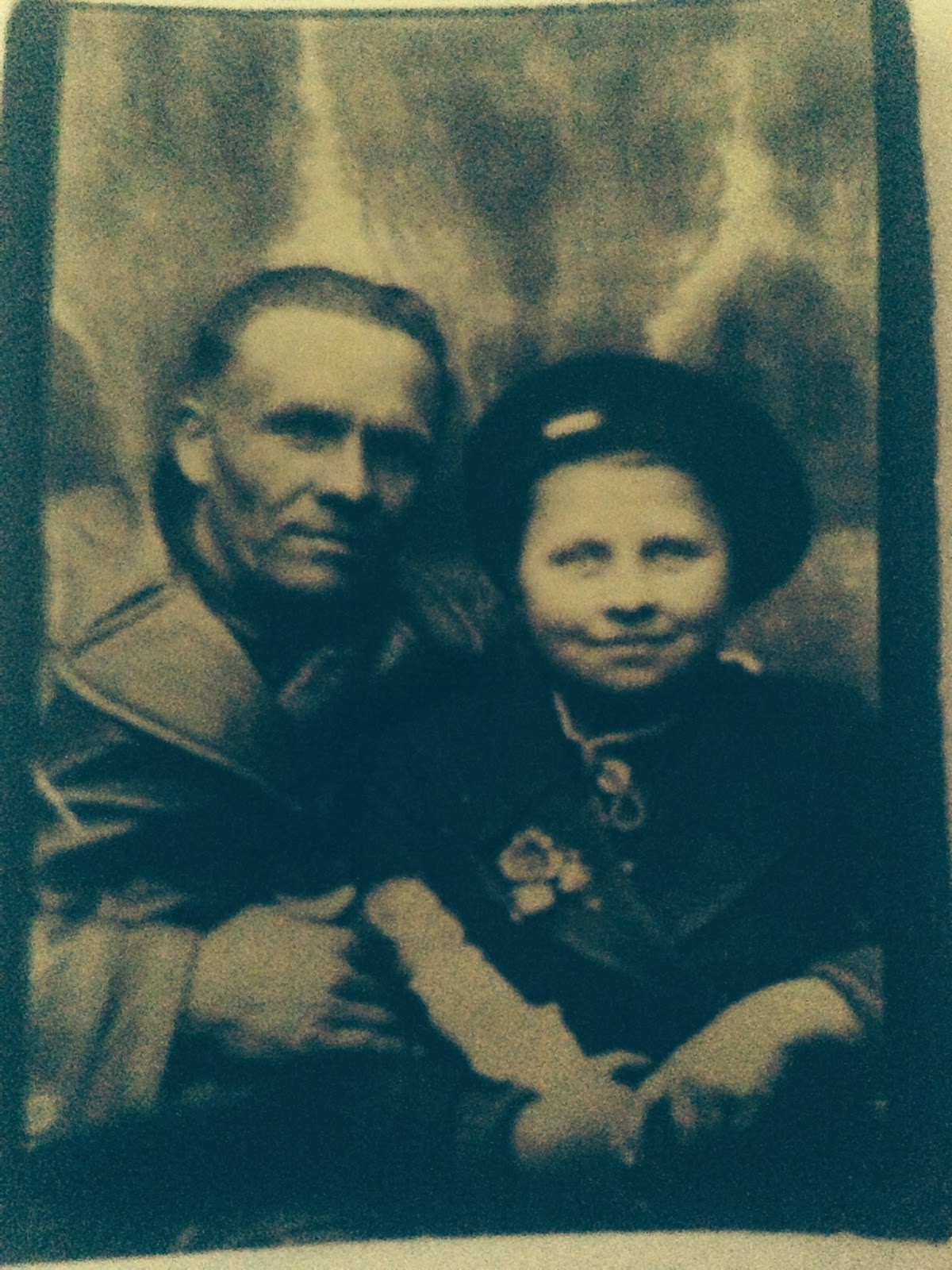
My mother with her mother, 1949. My mother with her
father, 1947. Both photos taken in Hanover, Germany. No photos exist of my mother before the displaced persons camp in Hanover. 

Sigmund Freud referred to survivor’s guilt following his father’s death, in a letter to his friend, otolaryngologist (ear, nose, and throat doctor) Wilhelm Fliess, referring to “that tendency toward self-reproach which death invariably leaves among the survivors.

Simply put, it’s the feeling that you have harmed others, especially loved ones, just because you were spared death when they died. The term "survivor syndrome" was coined in 1961 by psychoanalyst W.G. Niederland, who in the 1950s began studying concentration camp survivors.

Among survivors of World War II concentration camps, guilt is sometimes manifested in strange yet subtle forms, such as behaving as if they themselves are dead, inhibiting themselves from success or engaging in self-destructive acts in response to survivor’s guilt in regard to a dead parent or sibling, A H Modell revealed in a seminal article published in 1971 in The International Journal of Psychoanalysis. I recall one instance when my grandfather lied down under his car, acting as if he were dead. I was a young teen. I was horrified. I knew it had something to do with his experiences, and I felt guilty for lacking the psychological study to identify his condition. (I have an unsupported theory that survivor’s guilt is passed down to the next generation more so than other forms of guilt.)

“Survivor's guilt constitutes the failure of the psychological immune system to grapple with tragedy of great magnitude. Like an infection that overwhelms the body's immune system, survivor's guilt overwhelms the psychological immune system. Instead of exaggerating the difference between oneself and a victim, the similarity is what strikes people as most obvious. ‘That poor guy was no different from me; it could just as well have been me instead of him.’  With survivor's guilt, the differences between oneself and another person shrink, and so too do the differences between what actually happened and what could have happened. As with a bad infection, the best recourse is medical treatment,” writes Neal Roese, Ph.D., in his 2005 book, “If Only: How to Turn Regret Into Opportunity.”

I find this fascinating, as I've often wondered if there was any correlation between people of my mother’s (and grandparents’) immigration and a proliferation of autoimmune diseases. I rarely share this premise, as finding Western medical professionals who even discuss something that’s not published in a study they read or wrote is generally impossible. In any case, I know more than most people outside of endocrinology about autoimmune diseases as it took decades for me to find a doctor to properly diagnose mine. I'd been confident for years that I had some form of autoimmune hypothyroidism, as my maternal grandfather suffered from hypothyroidism and my mother had a thyroidectomy. My grandfather wasn’t diagnosed until it was too late, when he was hospitalized for what may have been delayed symptoms of a nearly fatal car crash that he “miraculously” survived, doctors and first responders told me at the time. (At 15, I was in the ambulance and in the operating room with him.) My mother’s hypothyroidism also went undiagnosed and untreated for decades. Doctors blamed my symptoms on anything else, even my own behavior, and refused to send out blood work for a quick, simple and cheap test of free levels of triiodothyronine (T3) and thyroxine (T4), which together regulate your body’s temperature, metabolism and heart rate, because my "TSH (or thyroid stimulating hormone) is fine." Finally, I found a doctor who’d written an article on a study that articulated exactly what I’d been telling other doctors, and he immediately diagnosed me with Hashimoto's thyroiditis, a genetic disease. My mother’s mother had rheumatoid arthritis, and my sister is afflicted with RA, along with Lupus and Raynaud's phenomenon (RP) – all autoimmune diseases.  So many people I knew growing up from the same immigration also suffered from various autoimmune diseases, while diabetes and heart disease was extremely rare in this community. These people grew their own vegetables and fruits, fished and only bought meat if they knew how the animal was slaughtered. This was in the third-largest city in Massachusetts and fourth-largest in New England. My grandparents kept hens in a perch of shelves that my grandfather build into a one-car garage, grew dozens of vegetable varieties and berries, and even kept and slaughtered their own pigs. I often went fishing (at a nearby lake) and mushroom picking (at a nearby forest) with my grandfather. I picked berries from the small yard and helped collect eggs from the hens. My grandfather volunteered as a beekeeper at the monastery where he’s now buried on his vacations from factory work and brought home the equipment to keep hives in the yard.

My unexamined autoimmne hypothesis aside, there’s been even less done to psychologically diagnose these people and treat their obvious survivor’s guilt and often posttraumatic stress disorder (PTSD). This is an unforgivable failure of our mental health system and our society at large. America has welcomed the “wretched refuse of your teeming shore” but it has done nothing to help those huddled masses heal from the incomparable suffering of surviving war after war. PTSD and survivor’s guilt is so rarely used in conversations about anyone but U.S. military veterans. Unarmed civilians suffer far more than soldiers. PTSD and survivor’s guilt are often confused, even by trained specialists, but they are very different phenomena. While PTSD is psychopathological phenomenon, survivor’s guilt is more of an expression of a normal concern for other human beings, both as individuals and as a society.

My intention is never to undermine the struggle of soldiers. My father was a decorated veteran who served in the South Pacific and in Korea, and is immortalized in The New Orleans D-Day Museum. Many men in my family have served in numerous wars and conflicts. But when they volunteer or they’re drafted or recruited, soldiers are warned of the trauma to come, even if they cannot effectively prepare for it. Even the most distressed societies make an effort, and often a promise, to protect civilians, yet no adult or child ever is warned of the sudden terror that leads to destruction of what was a civil society. My mother also was robbed of a childhood, adding another level of stress to her guilt.

“The various effects that adults who were child survivors experience can be attributed to many aspects of their traumatic exposure. Children and adults were treated differently in the camps and consequently their emotional reactions were different. Children were likely too traumatized during the war to experience ‘true’ childhood,” writes Fara Kaplan in “Holocaust Survivors and Their Children: A Search for Positive Effects” published by The American Academy of Experts in Traumatic Stress. “Also, because the child's identity had been in a state of development, their experiences may have remained buried in their memory (i.e., unconscious). This may have impeded their ability to empathize with others and likely negatively affected their adjustment to their own offspring.”

For my mother, the survivor’s guilt from early childhood is compounded by the losses of her parents and my father, all of whom she cared for at home until their deaths from very serious illnesses. The Russians (and Eastern Slavs) I knew growing up did not sentence their sick and old to death in nursing homes. “How can I do that to my parents when they didn’t let me die?” my mother has said, or stated, many times. Of course, she was equally compelled to care for her dying husband. My grandfather’s illness was, mercifully, short-lived: he died about a year after he became bed-ridden, his wife and his daughter as his constant bedside companions. After he died, my grandmother was bedridden for nearly nine years, her (long undiagnosed) brain atrophy prohibiting her from speaking. She would, however, sometimes cry in a chanting tone that clearly signified the mourning of her loved ones, especially her infant sons.  My father was diagnosed with Stage IV colon cancer, metastasized to the liver, shortly after my grandmother died. I’ll spare the details of what such care involves, as I know most Americans lack the palate for visceral reality. But my mother completely gave up her life from 1987 until 2002. She hasn’t recovered from that trauma enough to indulge in what are very basic creature comforts for the average American, such as treating herself to a movie or a vacation – ever.

In a 1972 article in Psychoanalytic Quarterly, Stephen M. Sonnenberg, M.D., cites a case study involving a patient who felt guilty that her husband had died during surgery she authorized, after caring for him during a nine-month illness. “She also expressed feelings of guilt concerning the murder of her parents and younger sisters by the Nazis,” notes Sonnenberg.

“With (her husband’s) death, she not only felt guilt concerning him but she lost the opportunity to expiate her long-standing guilt by being a good nurse. In her unconscious, it was as if she had willed the suffering of her past loved ones in an effort to be close to them. Thus, guilt over past events became overwhelming. It would seem that this patient was a guilt-laden woman who lost a guilt-expiating object and at the same time underwent an experience that confirmed her past and present guilt. Signing for 'experimental' surgery was perhaps the final burden, and her obsession over it became clear in her treatment. While she insisted that her husband's good health had been her goal, she also felt that she was a 'murderer.’ Depression was present when anger at the lost object was conscious and when identification with the lost object did not exist. It was the strength of her guilt that made her feel so hopeless and depressed.”

Shulamith Kreitler, Frida Barak, Yasmin Alkalay and Nava Siegelman-Daniel conducted study of 195 family members of cancer patients who had been involved in the care of the patients and had a continuous relationship with them, which found that that survivor’s guilt is prevalent among the caretakers of cancer patients.

“It is distinct from the experiences of guilt and of remorse,” they wrote in paper “Survivor’s Guilt in Caretakers of Cancer” based on the study. “Survivor’s guilt is an affective response rooted in deeper layers of the personality. Most importantly, the observations about the correlates of survivor’s guilt six months following the patient’s death support the theses that survivor’s guilt exerts a pro-social impact on the person’s behavior and that it helps maintain the presence of the deceased in the life space of the survivor. Both of these effects led the deceased a kind of metaphorical immortality, thus helping the survivor preserve his or her own sense of immortality and the sense of continued contact with the deceased. In these respects survivor’s guilt contributes to overcoming death, at least on the psychological level.”

This desire to commune with the dead also plays into my mother’s religious beliefs and practices. Russian Orthodox Christians do not close the casket until it is taken from the church to the cemetery. My grandmother’s body was returned to my parent’s home where she died after being taken to the funeral home. A wake was held at home, with many non-Orthodox Christians in attendance, and kept my grandmother there until being transported 166 miles away to the monastery church. (I drove my mother’s car, following the hearse, which was nearing speeds of 100 mph. It was exhilarating.) Psalms are read over the body continuously and throughout the night until the funeral begins. In the words of the fathers of the seventh ecumenical council: “God re-created man in immortality, thus bestowing upon him a gift which could no longer be taken away from him.”

Nietzsche said Dostoevsky was “the only person who has ever taught me anything about psychology.” In Dostoevsky’s work, guilt and sin are existential conditions of man, and each of us is somehow guilty of everyone’s sins. Nietzsche began reading the work of Dostoevsky, who died in 1881, in 1887, finding inspiration in a fellow challenger of the fundamental world view of the Enlightenment. Religious belief is what divides the two. Dostoevsky ultimately believes in salvation and therefore an afterlife, a view Nietzsche boldly rejects. But they share a very similar perspective on guilt.

The confession of Raskolnikov, which leads the protagonist in Dostoevsky’s Crime and Punishment to prison, clearly had a profound impact on Nietzsche’s philosophy.

"Throughout most of human history, punishment has not been meted out because the miscreant was held responsible for his act, therefore it was not assumed that the guilty party alone should be punished: but rather, as parents still punish their children, it was out of anger over some wrong that had been suffered, directed at the perpetrator, but this anger was held in check and modified by the idea that every injury has its equivalent which can be paid in compensation, if only through the pain of the person who injures. And where did this primeval, deeply-rooted and perhaps now ineradicable idea gain its power, this idea of an equivalence between injury and pain? I have already let it out: in the contractual relationship between creditor and debtor, which is as old as the very conception of ‘legal subject’ and itself refers back to the basic forms of buying, selling, bartering, trade, and traffic." _ Nietzsche, On the Genealogy of Morals (1887).

It’s impossible for me to imagine a guilt more “primeval, deeply-rooted” than survivor’s guilt.


Wednesday, December 4, 2013

A Disputed End and a Happy Beginning


“I don’t remember when the war ended,” says my mother. She’s not acknowledging (like most of us) that she forget what she learned in high school history class. For her, the day the Nazis surrendered marks one of many heightened emotions from a traumatic and tortured early childhood. It’s what immediately followed that matters.

But even those who make a career out of documenting such events are at odds over the date.

Nearly seven decades later, historians still dispute precisely when World War II ended in Europe, a tender topic that remains tricky turf for The Associated Press, the breaking news military of journalism where I spent nearly a decade as an editor in the ‘90s and noughts.

Some claim the war ended at the armistice of Aug.14, 1945; others contend it ceased with the formal surrender of Japan on Sept. 2, 1945.

Brooklyn-born Edward Kennedy cut his teeth at newspapers for seven years before he was hired by the AP to work in Pittsburgh and Washington, D.C., and then assigned overseas. He was in Valencia and Madrid to cover the Spanish Civil War, then in Rome to report on Mussolini’s Italy. His storied career includes dispatches from France, Hungary, (what was then known as) Rumania, (the former) Czechoslovakia, Bulgaria, Turkey, Greece, Syria, Egypt, Libya, Iran, Iraq, Palestine, Lebanon and Algiers.

It wasn’t until May 7, 1945, that he became a historical figure himself when he witnessed the surrender of Nazi Germany in Reims, France. The announcement was embargoed by Gen. Dwight D. Eisenhower, but Kennedy couldn’t get a response from the censors and decided himself to act as the newsman that he was and release the news.

Kennedy’s dedication to his job got him fired, even though he exonerated his reputation by proving that the U.S. military had permitted the Germans to release news of the surrender while maintaining the embargo on the media.

But it wasn’t until last year that the AP apologized to Kennedy, who had been dead for nearly half a century.

“It was a terrible day for the AP. It was handled in the worst possible way,” said AP president and CEO Tom Curley. Kennedy, he said, “did everything just right.”

Churchill and Truman had secretly agreed to keep mum until the following day, when the Soviet Union would accept the capitulation of German forces in Berlin. The Big Three wanted to stick it to Stalin and announce the end of the war together on May 8, or "Victory in Europe Day.”

The New York Times ran Kennedy’s byline on the May 8 front page, announcing that THE WAR IN EUROPE IS ENDED!


Thankfully there still were newspapers in the 20th century and Kennedy went on to work as managing editor of the Santa Barbara (Calif.) News-Press, and then as associate editor and publisher of the Monterey (Calif.) Peninsula Herald (now the Monterey County Herald) until his death in November 1963.

For my mother, the exact date bears little significance, but the action is life changing – or life beginning.

“After the war ended, we were free to go anywhere,” said my mother. “During the war there was nothing. We didn’t have anything.”

My mother’s story trails back to life before the farm and then she circles back to her journey and arrival at Lyssenko Displaced Persons Camp in Hanover or Hannover, Germany. Alexandra Tesluk Gibson, who was born at Lyssenko and is the author of memoir The Ashes of Innocence, has been back to the former camp. My mother, who hasn’t left the U.S, save for short trips to Canada, since 1950, immediately remembered exactly where she lived when I showed her the photos of the barracks that Alexandra had posted. My mother vividly recalled that she and her parents used the second door from the left of the giant building and that a close friend and her family used the first door, which connected from the inside to hers. There were four resident entrances, and the two to the right also connected inside, says my mother.

Even before seeing the photos of the building’s modern day exterior, my mother said: “these were very, very large barracks. In each room -- they were big -- we had four families and each one of us had like a corner. And by that time we were given foods. Certain foods. Rationed foods. And we were also given packages of clothes afterwards, they were sent from America and from England.”

Over the Thanksgiving weekend, my mother shared with me dozens of photos, mostly from Lyssenko.

The authentic laughter re-emerges when my mother recalls “I remember this one package that was sent, and it said it was for a child my age, and I wanted that one even though I think it was a little bit too small for me. (giggles) But it was a beautiful coat, so I wanted the biggest one in the package. (giggles) I still remember that coat. It had some kind of checkered pattern on it and it was red or maroon. But it was quite small on me. I guess I later traded it with someone, but I wore it a couple times.” (giggles)

The photos from Hanover reveal the first signs of living for my mother.

“We had a good time, you know, we were allowed to go to school and we were in a British zone and we were in a Ukrainian camp, but we were not allowed to speak Russian. We had to speak Ukrainian. And that's why now my Ukrainian, Russian and Byelorussian sort of sometimes blends together.”


“The life there was very good. I had friends, I went to school and I even went to a carnival, and went to movies.”

Thursday, November 14, 2013

The Goal and Intention of Lubachka, The Novel


Lubachka is not an attempt to write or rewrite a controversial period of history that has been recorded with great inaccuracy, sometimes as a result of intentional bias but more often because the memories of survivors are as convoluted as the emotional trauma and psychological struggle that accompanies such experience. Each survivor's experience is unique and powerful as a tool for comprehending how war impacts civilians and forever changes their lives. The collective history is told only through battles, and how the seats of power are shifted. That the weaponry and strategy continues to interest people, particularly those who have never served as soldiers, speaks volumes about the psyche. Americans, in particular, are inclined to focus on these details in order to distance themselves from the suffering of people like my mother. I lack any ability to connect intellectually with adults who tinker with toy soldiers like a sheltered child. It is cultural history, not military history, that, utilizing narratives such as Lubachka, can help us begin to understand humanity. Battle logistics are only significant in tracing the paths of those who were lost at war and those survived. The important story has been buried in the daily lives of people like my mother.

Through the lens of those who witnessed horrific atrocities comes profound and important insight into humanity, which must be considered alongside the triumphant accomplishments of humanity, such as great art and literature, both contemporary and contemporaneous.

As a former scholar (of literature not history) and as a journalist for more than two decades, I approach this project with the research skills I have developed. This is not, however, intended as a sweeping academic or investigative work. It is a layman's effort at contributing to the memory and shared experience of survivors like my mother, regardless of nationality, ethnicity or religion.  Any statistics I cite are official, and I intentionally avoid engaging in any debate over the “real” numbers that break down how many were killed or died based on ethnic or national profile.

My mother and her parents identify themselves as ethnic Russians, though they all were born in Belarus, so close to the Russian border that my grandmother walked to church in Russia to baptize my mother. There are many confusing details regarding when and why certain people were sent to specific camps, and my mother and her parents were often the minority ethnic population at a particular camp even when there were more facilities designated for Russians. It is significant to note that while Belorussians were often counted differently from Russians (largely because of the Partisan resistance movement of which my mother and her parents were targets), Ukrainians are generally lumped into the Russian category on official statistics. I am a quarter Ukrainian and a quarter Polish on my father’s side. That alone is reason enough for me to avoid any conversation or conflict stemming from national or ethnic pride. My mother is Russian Orthodox and any discussion of religion serves to bolster the cultural context of heinous crimes committed against people of many different faiths.

Lubachka is largely based on my mother’s early childhood memories, but it is written by me. My mother chose to not write this herself, nor did she commission me to write it.  She did, however, speak openly about an extremely traumatic period of her life. This is not a fictionalized account, nor is it written from my mother’s voice. I welcome critics for everything I publish, professional and personal, but I am not making any claims that are intended to set straight a record or undermine other people’s accounts. I welcome any information that might broaden my own understanding of the events surrounding my mother’s experience.

I’ve grown up in a world where “educated” people (those who have earned at least a bachelor’s degree from a college or university) have used the term Soviets after 1991 to describe people who live in (or hail from) countries bordering Afghanistan, China, (the former) Czechoslovakia, Finland, Hungary, Iran, Mongolia, North Korea, Norway, Poland, Romania and Turkey. My frustration is nothing compared with my mother’s. Imagine watching all your siblings die in infancy and surviving concentration and slave camps only to be met with ignorance in a free America where you are marginalized and ostracized by people who were brainwashed by McCarthyism.

This is intended as an explainer, not a disclaimer. I am not Lubachka, but of course I am psychologically and socially impacted by my mother’s life story. Every effort is made to present information without cultural bias, using historical documentation as a framework for the events and experiences she describes. This is a deeply emotional account and I strive to represent all information with integrity.

Friday, October 25, 2013

A Brief Period in Lublin Has A Lasting Impact


My mother has lived in the same split-level ranch atop a steep hill on a quiet cul-de-sac that empties into a town nature preserve which was an active apple and peach orchard throughout my childhood. She has many excuses for not moving out after my father died in 2002, all while acknowledging that it is a burden to clean a three-bedroom house (where she lives alone) and to maintain a large lawn with many trees. My mother is not the type to hire a housekeeper, ever. (Her mother worked as a housekeeper for many years, including when I was an infant and I went to work with my babushka while my mother studied.) As stubborn and strong-willed as they come, my mother also is reluctant to hire anyone to clean the gutters, rake the leaves, mow the lawn, shovel the snow, trim the shrubbery, clean the garage, haul large objects to and from the basement or perform myriad strange cleanup tasks that arise from the wave of unusual weather events, including tornadoes that touched down in 2011, that have hit Western Massachusetts in recent years.

My Western mind insists she’d be better off in a nice condo with other self-sufficient retirees where she could trade manual labor for activities that don’t require a hard hat. But my Eastern soul sympathizes and understands that for my mother moving comes with a lot of baggage that you can’t hire someone else to haul. (Save for a really great therapist.)

By the time she was four years old, my mother had moved to three neighboring, yet warring, countries: Belarus, Poland and Germany.

Now the ninth largest city in Poland and regarded as a European cultural capital, Lublin was a very different place when my mother and her parents were forced to relocate there.

Majdanek, a concentration and forced labor camp, and briefly a death camp, located about three miles outside the city, opened in September 1941, initially for Soviet prisoners of war. It is estimated that 360,000 people, including 120,000 Jews, died or were murdered at Majdanek. The inmates represented 54 nationalities from 28 different countries, including the Soviet prisoners of war and Jews from Poland, Germany, Czechoslovakia, the Netherlands, France, Hungary, Belgium and Greece, as well as non-Jews from Belarus, Ukraine and across Poland, who were taken to the camp as political prisoners and slave laborers. 

“I remember the house, the room, that we lived in,” she recalls. “It didn’t have a floor. It was a dirt floor. That much I remember. And the people whose house we were living in, that woman had a baby and they had a christening and they had food there, and drinks, and so I came up to the table and I took what I thought was a glass of water, but it was actually vodka! Homemade vodka!” 

Laughing, my mother says she was “Four, something like that, four and a half. I don’t know, maybe even five. I don’t really remember how old I was. But I do remember we were living there, and one of my aunts (my mother’s sister, Marta) was living in another house close by, but we could see it out the windows.”

“It was really a big chaos. The Germans would come and try to kill us, and the Partisans, I guess, would try to kill us. They used to take usually men. Men would be hiding and I just remember –- sort of remember -- how they would take someone and there'll be like two soldiers on each side and one walking with a gun after them. And it was just very, very terrible. But then one time, when they were taking us further and further, towards Germany, we had to sleep outside. I only had one set of clothes, which I wore all the time, I slept in it … It was like a jumper, I guess, and some kind of a shirt or blouse underneath and I guess I did have a coat. I must've had a coat because it was cold at times. We lived that way for a long time, and I got lost one time from my mother and father.

The passing of time for this brief but life-altering period in my mother’s early childhood was measured only by changes in weather and the deaths of her brothers and other friends and loved ones. 

“We at that time somehow had a cow, and I was holding onto the cow and they pushed me away, and this must've been after the spring, after my brother died … There was grass on the ground and the cow was eating the grass, and then after looking and looking for my mother, I didn’t find her, and I just laid down in the grass crying, but I was still holding onto the leash of the cow, and then my mother found me. But then after, shortly after that, the Germans took the cow away from us, too. They took everything. Whatever we had, we didn’t have anything anymore.” 

The next thing my mother recalls is boarding a freight train when she was about five years old.

Lublin changed rapidly and dramatically when the city was taken by the Soviet Army on July 24,1944, and it became the temporary capital of a Soviet-controlled communist puppet government, the Polish Committee of National Liberation. The Polish capital was moved to Warsaw in January 1945. After the war, Lublin’s population quickly grew and it became a major scientific and research base and home to large automobile factory. After the war, Jewish Holocaust survivors in hiding or in Soviet territory had re-established a small community for a short time but most quickly left Poland for Israel and the West. Survivors like my mother and her parents were herded to a displaced persons camp in Germany.