Showing posts with label Nazis. Show all posts

Friday, July 26, 2019

Dyadya Misha and the Holy Archangel Michael


 “I really don’t think I remember much of my childhood except a horrible war. And when the war sort of ended, but it wasn't ended yet, the Germans were still there and they had let us open some churches. My brother Mikhail, Michael, was still alive at that time, and that's when he was baptized in the church, when it opened.”

“Oh, it was a beautiful, big church. I saw angels singing on top of the church, but when I was telling someone that I saw angels, they said I probably just heard people singing.”

Tears well up as a girlish smile emerges and Lubachka unearths some joy from the recesses of a brutal early childhood. Lubachka is affectionate for Luba, which is short for Lubov, which means love. Luba is my mother. Named for a Holy Martyr, who at age 9, was tied to a wheel and beaten with rods until her body was covered with bloody welts.  She and her older sisters, Faith and Hope, survived being burned over an iron grating, then thrown into a red-hot oven, and finally into a cauldron with boiling tar.

Did Lubachka see angels?

Maybe.

Maybe it was the hunger or the dehydration causing hallucinations.

Maybe it’s something none of us can explain and some of us want to believe. The word angel is derived from the Greek word angelos and the Latin word angelus, both meaning messenger. We all hear messages.

I hear voices, though they’re far from divine. I hear voices when I’m asleep. I hear voices when I’m paring down a few thousand words of analysis, emotion, and research into a thousand never-quite perfect words, in an hour before I race out the door to school for pickup, halted suddenly by the slow flow of leisure parents who have been lingering outside the building for hours, complaining that they won’t be able to head “down east” until Thursday this week.

I hear voices when the subway stops between stations for a sick passenger in another car and swim team practice is about to let out and I have to get the puppy and walk her over to the rec center to meet my son.

I’ve heard a voice, just a few times, that told me if I meander into rush hour traffic while an 18-wheeler and a MTA bus blow through a red light, that nobody would suspect suicide when I’m flattened into the pavement.

Sometimes I’m floating or cutting through gentle waves in the Caribbean Sea, or pushed up against a throng in a nostalgic trance on the floor at a show, and the voices stop. They always pick up again when I can’t sort out which anxiety is keeping me awake and there’s few precious hours before daylight.

Maybe it’s my Dyadya Misha, my Uncle Mike, telling me it’s OK. Maybe he’s trying to break through my stubbornness and ego to remind me that I have to be more forgiving of my mom, not because she sees angels or hears voices, but because we all hear voices.

Maybe I should listen. We invoke Saint Michael for protection from invasion by enemies and from civil war, and for the defeat of adversaries on the battlefield. He conquers all spiritual enemies. Over all the Nine Ranks of the Heavenly Powers, the Lord appointed the Holy Archangel Michael (his name in Hebrew means “who is like unto God”), the faithful servitor of God, as Chief Commander.

At least little Michael, Mishinka, lived long enough to be baptized. In the Orthodox faith, babies are baptized about three months after birth. Mishinka was immersed in sanctified water a little later, as there was no escape from holding places in camps to do it secretly. Lubachka’s two younger brothers died in infancy, unbaptized.

Did angels appear when Mishinka’s frail body was tossed into a mass grave?

Most of Lubachka’s loved ones were dumped into unmarked pits, some with limbs mangled and dismembered, genitals violated and mutilated, but essentially in tact to resemble the remains of a human form. Others with brains blown out by the stock of a rifle, to save bullets. Hitler explicitly ordered a surge in ammunition production in early 1940, for fear of the shell crisis that’s widely blamed for toppling the Kaiser’s armies in the autumn of 1914.

The most traumatic memory isn’t the moment of Mishinka’s death, it’s a moment of regret.

Lubachka’s memory impetuously blinks back on, like a light bulb dangling from a frayed wire, to retrieve another visceral early childhood experience, one she’d likely repressed.

“I do remember something which I'm very upset about. My little brother Michael became sick because there was this one room where we lived with four or five families because we all lost our houses and everything. But it was not where I was born in Vitebsk Oblast near the Russian border. It was somewhere farther away, closer to what is now the Polish border. My mother was in quarantine because she had typhoid fever, and my little brother Michael was still breast-fed at that time, and she wasn’t with us and the two of us were left there, and this one woman in another room had a cat, and it was a cold, a very, very cold autumn day.”

“It was very cold outside. And, of course, he wasn't dressed, he only had a shirt, like some kind of an undershirt. The woman with the cat came and threw him outside, and I wasn’t able to pick him up or anything because I was too small. And then that's when he got very sick. For what seemed like a long time, he was very sick, and there was another girl that was my age that lived in that room, and we were playing cards, and my little brother would cry, and I would get very angry at him because he was disturbing me. To this day, it tortures me that I was angry at him. That I did that.”

“The woman with the cat, she was Polish, and her daughter had affairs with the German soldiers, so they had everything. We didn’t have anything.”

Everything, in this instance, means enough clothing to cover a full body or enough food to keep children alive.

The cause of Michael’s death remains unknown, but the timing spurs a rush of atrocious memories. In the mind of a child, Mishinka was ill for a long time, but his feeble breath lingered and his weak heart ticked only a little longer than that of his twin Ivan and their youngest sibling Pyotor.

“When my little brother Michael died, that's when my grandmother, my father's mother, and his sister were very brutally killed.”

Michael died in “either October or November. I don’t know. I don’t know what year it was. Maybe 1944, probably 44. And the thing is, we were living at that time where the German soldiers were, but my grandmother, my father's mother, and his sister that were killed, they were killed in a place the Partisans watched in the daytime, and the Germans would be there at night. The Partisans were there, or the Germans, I don’t remember. But anyway, somehow, I do sort of remember going to the graveyard, and they were all, as far as I know, all killed and just buried in one, unmarked grave. But the graveyard was where we lived before the war started.”

Lubachka can’t recollect how or why they’d returned to the border of Smolensk.

“My aunt, at that time, was in school in Russia where they had to learn German. The German soldiers took her and another 16-year old, and they were asking who is living in this house, and they had a list of people and they were told to burn down their houses.”

“She was 16, so of course, she's going to say whose house it was. She was lucky because her father was also a Partisan, and of course he wasn't there at that time, but he was in their party. And my father was against the Bolsheviks and everything else, and he was in a German zone. And so when the Partisans came after them, they told him whose house it was.”

“They came to get my aunt, they wanted just her. My grandmother, she ran after her daughter. And then they took them a few miles away from there, but they had to cross some kind of a river, and they were going to be interrogated there by the Partisans, where their headquarters were. But what happened, it became close to nighttime, and they had to get out of that region because I guess that's when the Germans were coming or something, so the Partisans said that we know what's going to happen with them. They didn’t want to waste the bullets.”

“So they used the other part of the rifle, the wooden part, and they beat their heads open. That's how they were killed, and when my father saw that, it really affected his mental state for the rest of his life. And so then we had to just, I guess, put them in ground, and we had to leave there because the fighting between the Germans and Russians was about to start.”

“And then when we got back to the place where we lived, and the second day, or I don’t know, maybe it was the same day, I don’t really remember. I was outside. And I saw my brother who was all in white, that's not the way he was buried. I guess I don’t know what he was buried in, that I don’t remember, but I saw him outside and to me he had represented an angel.”

Some two decades before my mother told me this story, I was standing over the open casket of her father, my degushka, my grandfather, at a monastery in rural Herkimer County, New York, a home for decades to the Shastokovich family for two generations.

Maybe I hallucinated. I’m certain there was an apparition in the form of a body outlined in bright light. There wasn’t enough sunshine pouring in through the stained glass windows of the cavernous church to explain what I saw.

I was tired. I had barely slept for days. I rarely sleep enough. Those voices keep me awake.

And when the time of our demise shall approach, and of our liberation from this body of clay, leave us not, O Archangel of God, without defense against the spirits of evil under heaven, who surround us to close off the ascent on high for human souls; so that, guarded by thee, without stumbling we may attain unto those glorious habitations of Paradise, where there is neither sadness nor sighing, but life without end.

Tuesday, May 13, 2014

The Quest for Childhood Memories

"Fairy tales do not give the child the idea of the evil or the ugly; that is in the child already because it is in the world already. What fairy tales give the child is his first clear idea of the possible defeat of evil. The baby has known the dragon intimately ever since he had an imagination. What the fairy tale provides for him is a St. George to kill the dragon."
_ G. K. Chesterton

As uncertain as the time and place of her own birth, Lubachka can trace her family history back only to “Russia someplace,” where her grandparents were born. Every detail is somewhat nebulous.

Affectionate for Luba or Lubov, Lubachka is what my mother was called by her parents’ friends and anyone their age or older. Diminutives are ubiquitous among Russians and nobody is known by just one variant of their given name. To my mother’s elders, most long dead, she is forever a child, a little girl who emerged from the darkest world and triumphed over death.

When my mother made her first confession at the age of 6 or 7 to a Russian Orthodox priest, she clenched her hands in prayer, tears stinging her innocent face and admitted to every sin she’d heard of, including murder and adultery. (Her very confession was a sin, to those who observe the most stringent interpretation of Orthodox faith, which regards listing the sins you have not committed or things you have not done as likening yourself to the Pharisee of the Gospel. It would be considered a form of boasting, though thankfully this priest was not a fanatic.)

The priest must have struggled to not giggle. “Why my dear, Lubachka,” he said, “when did you find all the time to commit these sins?”

Like her first confession, Lubachka’s early childhood encompasses the laundry list of tropes found in Russian folk tales as outlined by Russian formalist Vladimir Propp.

1. The Initial Situation (the setup) is a backdrop of war, attacks on all fronts by multiple enemies.

2. Though her parents survived, Lubachka lost many others, including authority figures, making The Absentations (someone leaves or dies) central to her tale.

3. Lubachka’s father made several Violations, including leaving the Soviet Army in fury.

4. In a series of small villages comprised of dueling ethnic and political groups, Reconnaissance was rampant, and often it’s unclear if someone is the villain or the hero.

5. There were countless instances of Delivery (the searching party discovers information), often by those disguised as friends and working for an enemy.

Lubachka’s first few years encompass most of the more than 30 tropes, which haven’t lost their universal appeal. These are woven through everything from The Odyssey to modern works such as Star Wars, Labyrinth and Pan’s Labyrinth.

Let’s stick with what is known.

My mother’s mother, Alexandra Dimitrievna (Dimitrieva) Grishaev, was born March 3, 1913, in Dubrovka, a village in Vitebsk Oblast. My mother’s father, Grigori Ustinovich Grishaev, was born Nov. 18, 1907, in Lagi, also Vitebsk Oblast. Both villages are located near the Russian border, and my maternal grandmother would walk to miles to attend services at the closest Russian Orthodox Church. The oblast (which means administrative region) borders Russia, Latvia and Lithuania, and is a major railway center with stations for lines between Russia and Ukraine, Russia and Poland, and Russia and Lithuania. Her maternal grandparents were Dimitri and Matrona, and her paternal grandparents were Ustin (Justin) and Natalia. She only recalls that they were born “in Russia someplace.”

My mother was the oldest sibling, the only girl and the only survivor. Her brothers all died as infants, and are still remembered as such in her daily prayers. She doesn’t recall exactly when or where her brothers were born.

In her words: “One of my brothers was born a year or so later than me. His name was Pyotr, which is Peter in English. And my mother had twins; they were probably like two or three years younger than me. One of them was Michael (Mikhail) and one was Ivan, which is John. And actually one of them didn’t live that long. And I, for some reason at that time, liked the name John better. And when they were lying on a bed or something I used to switch them because I thought my mother and father wouldn’t know the difference. [laughter] (My parents)  said something that one of them was weaker, and probably wouldn’t live too long, but they knew (I was switching the babies).”

Lubachka’s attempt to save her “favorite” baby brother echoes one of the four types of classic Russian folk tales: magic tales with a female hero, usually a girl, and focused around her ability to perform certain tasks. The others are: magic tales with a male hero; animal tales and magic tales about everyday life. Heroines in Russian folklore are held to higher ethical standards than their male counterparts. But the rules aren’t quite carved in stone. Girl heroes aren’t allowed to lie, but “half-truths” may be permitted. They can’t steal, but taking something from an evil character may be admissible.

While she survived, my mother’s early childhood is a tragic tale.

Says my mother: “I don’t know how my brother Peter died. I don’t know anything about that. He was an infant. And John died when the war was almost to start, it was like 19 … I don’t know … when the Second World War was starting. And John died soon after that. And Michael … we did not have any, hardly any food, to eat, and he got very sick. There were no doctors. He had pneumonia. And he was 2 ½ when he died.”

My mother says her brothers were buried in the tiny of village of Lemnitsa in Vitebsk Oblast, some 158 miles northeast of Minsk. There is nothing online but serial maps of Lemnitsa, searching in English or in Russian. It’s as if it exists only as a tiny pinprick on the massive expanse of a geographic region and only in the memory of the few survivors like my mother.

For my mother, Lemnitsa serves literally and figuratively as a giant grave, where nearly all members of her family perished along with all its other inhabitants. “That's where also my father's mother and sister were harshly killed, and his sister was 16 at that time,” my mother says. “That's where they are buried, too.”

Quests for Russian folk heroines can be as mundane as gathering firewood, mushrooms or berries in the forest or more like that of a male hero, a journey to a far-away magical land.

Even the everyday was magical for Lubachka, when it involved the rare appearance of a mushroom or a berry.

Lubachka’s first happy memory comes from when she was about three years old.

“Afterwards, when we moved into this house that was built, and I was very little, we didn’t really have that much food, usually, always, you know. And the people across the street, they had these … they made them for me… it was like hamburger meat or  meatballs. Just a little bit of meat and potatoes. And they gave me some. I thought that was the best thing I ever had.”

“And the other thing that I remember myself -- I really don’t remember too much of my childhood at all -- I do remember someone giving me candy one time, and ironically, I must've really wanted the candy for some reason, but I really don’t think I remember much of my childhood except a horrible war. And when the war sort of ended, but it wasn't ended yet, the Germans were still there and had let open some churches, and my brother Michael was still alive at that time, and that's when he was baptized in the church when it opened.”

She doesn’t recall the name of the church or the priest, but she speaks of a mystical experience, which punctuates her lifelong passion for Russian Orthodoxy and guilt, even now, over her tardiness to liturgy, even when she’s ill. The girlhood hunger for faith was as intense as the need for food to survive. My mother still thinks this way. It’s an inescapable passion.

“Oh, it was beautiful, big church. And I think, in my opinion, I saw angels singing on top of the church, but when I was telling someone they said I probably just heard people singing, and because there were probably paintings (of angels), so it was like a very large church. Yeah, to me it looked very good.”

She doesn’t remember anything about the cupolas, or onion domes, whether they were wooden or gilded.

“I don’t remember the outside. I just remember the inside of it. And, oh yes, there were a lot of people!” Most were strangers, bonded only by faith in Orthodoxy or at least a transfixion with the church itself, finally erected, open and serving a safe place to seek refuge for the soul or body. “I was too little. I didn’t really know anyone there. The church was full.”

My mother’s memory shifts suddenly to retrieve another visceral early childhood experience, one she’d likely repressed.

“And then I do remember something which I'm very upset about. When my little brother was sick, Michael, I was a little bit older, and well, actually, before he got sick, the reason he got sick is because there was this one room where four or five families of us lived because we all lost our houses and everything. But it was not where I was born or where I lived, it was somewhere farther. (Possibly closer to what is now the Polish border.) And what happened is, my mother, she was in quarantine because she had typhoid fever, and my little brother was still breast-fed at that time, and because she wasn’t with us and the two of us were left there, and this one woman that had a cat in there, and it was a cold, a very, very cold autumn day. It was very cold outside. And of course, he wasn't dressed, he only had a shirt. Like a T-shirt, some kind of an undershirt on, and she threw him outside, and I wasn’t able to pick him up or anything because I was too small yet, too. And then that's when he got very sick. And he had to leave late in the night. I don’t know if it was like a crib or something like that, for a long time he was very sick, and there was another girl that was my age that lived in that house, and we were playing cards with her, and my little brother would cry, and I would get very angry at him because he was disturbing me, and so that actually to this day tortures me. That I did that.”

“The woman with the cat, she was actually in the other room, but she was Polish, and her daughter had affairs with the German soldiers, so they had everything. We didn’t have anything.”

“Well, I don’t know. She was a woman at that time because she did have a daughter, I think. She was not a young girl. She was probably in her twenties. No. No, I don’t remember that woman's name. And then at the same time, when my little brother Michael died, that's when my grandmother, my father's mother, and his sister were very brutally killed.”

Michael died in “either October or November. I don’t know. I don’t know what year it was. Maybe 1944, probably 44. And the thing is, we were actually living at that time where the German soldiers were, but my grandmother, my father's mother and his sister that were killed, they were in a killed (by the Partisans) in a place that in the daytime, the Germans would be there at night. The Partisans were there, or vice versa, I don’t remember. But anyway, somehow, I remember, I do sort of remember going to the cemetery, and they were all, as far as I know, all killed and just buried in one grave. And but it was the cemetery, where we lived before the war started.”

My mother says they were killed by the Belarusian Partisans, resistance fighters who fought the Nazis and collaborationism during World War II.

“My aunt, at that time, was in school in Russia where they had to learn German. The German soldiers took her and another 16-year old, and they were asking who is living in this house and this house, and they had a list of people who they were told to burn down the houses. She was 16, so of course, she's going to say whose house it was. She was lucky because her father was also a Partisan, and of course he wasn't there at that time, but he was in their party. And my father was against the Bolsheviks and everything else, and he was in a German zone. And so when the Partisans came after them they told him whose house it was, they came to get my aunt, they wanted just her. My grandmother, she ran after her daughter. And then they would go and take them a few miles away from there, but they had to cross some kind of a river, and they were going to be interrogated there by the Partisans, where their headquarters were. But what happened, it became close to nighttime, and they had to get out of that region because I guess that's when the Germans were coming or something, so the Partisans said that we know what's going to happen with them, so they didn’t want to waste the bullets, I guess.”

“And so they used the other part of the gun (rifle), the wooden part, and they beat their heads open. That's how they were killed, and when my father saw that, it really affected his mental state for the rest of his life. And so – [sobbing] then we had to just, I guess, put them in ground and we had to leave there because the fighting between the Germans and Russians would start. And then when we got back to the place where we lived, and the second day or I don’t know maybe it was the same day, I don’t really remember, I was outside. And I saw my brother who was all in white, that's not the way he was buried. I guess I don’t know what he was buried in, that I don’t remember, but I saw him outside and to me he had represented an angel. That, I think, I just made up. No one was able to tell me that. I think that I remember myself.”

“I think I do remember, I saw when the fighting was going on between the Germans and Russians -- I'm not sure if it was Partisans or the or the, Russian Army. I don’t know, I never asked my parents what army it was. But I know at that point I just saw the Germans afterwards because they're the ones that took us as prisoners after, so I really didn’t see any Russian soldiers after that. And there was a wagon full of stuff and we were walking on one side, and this other girl, about my age, was walking on the other side, and the grenade was thrown, and she was very close to me, and she got killed, and I didn’t. And of course there were other people that were killed but I remember her because she was a friend of mine, you know? And that was very, very tragic.”

“And then, after that, Germans were moving us from one place to the other. And I remember we lived in Poland for almost like nine months. In Lublin, which was going back from the Russians to Poland.”

Wednesday, March 26, 2014

Reliving Trauma by Mourning "Bad" Deaths


It was something like: “Ooooowhoawoahoooo!” The exact sound is impossible to convey in writing, but I can still hear it.

“Ooooowhoawoahoooo! Ooooowhoawoahoooo! Ooooowhoawoahoooo!”

My grandfather – my beloved Degushka -- the strong, stubborn, handsome, well-coiffed, impeccably attired, intimidating and often-argumentative man who I admired and idolized despite his prominent character flaws, was bellowing.

The chaotic chorus of “Ooooowhoawoahoooo!” was thunderous yet muffled. I called for him. In quickfire Russian, he warned me to hide, too. “They are coming! They have killed my sister and my mother! They will kill us all!”

Terrifying, but not delusional. His mother and sister were brutally murdered some seven decades ago in Belarus. Though on a quiet street in a Western Massachusetts suburb in the mid-1980s it would have struck any other passer-by as the ranting of madman, even though nobody else understood what he was saying.

As a tween and young teen, I volleyed between my parents’ house, about a mile-and-a-half away, and my grandparents' house. I forget why I was headed there, that day at that time. It was an otherwise mundane day that had gone -- by any middle-class suburban American standard existing at the time -- mad.

Deugshka was hiding under his car parked in the driveway, supine, legs straight, right arm crossed over left as if he were preparing to accept communion or his body readied for funeral and burial in the Russian Orthodox Church.

It was one of those moments. When I first learned the term posttraumatic stress disorder (PTSD) on the TV news, it referred to soldiers in the Vietnam War. As I came to understand it, I realized my grandfather was having a flashback, another term that had taken on a very different meaning in my social education. It wasn’t the first time I’d witnessed something like this, and certainly not the last. But feeling exposed on the driveway, even though nobody reacted, made me self-conscious. Already I was an outsider in this world of WASPs and other people who had no connection to the generation of their family that first arrived in America. Now this.

I was frustrated, scared and worst of all helpless. What could I possibly do? Get the keys and attempt to slowly roll back the car, hoping he didn’t budge? Attempt to drag him out? None of this was feasible. The episode, like all others, passed, but the impact was forever imprinted.

In the last years of her life, my Babushka, my mother’s mother, entered trancelike states where she would moan in a somber, steady stream of cries of and gasps for breath. The sound was similar to her husband’s “Ooooowhoawoahoooo!” but heavier and more sorrowful. In a PTSD flashback, she was mourning the deaths of her three young sons and countless close relatives and friends who died during my mother’s early childhood.

In all the years my maternal grandparents underwent tests for various medical conditions, not a single doctor ever mentioned PTSD.

With my mother, there also is no talk of PTSD, no mention of survivor's guilt or survivor's syndrome, which clearly is the root of her anxiety and stress related to what might otherwise be considered normal circumstances or situations. My mother feels guilty for surviving when her three brothers and peers perished. The Diagnostic and Statistical Manual of Mental Disorders, published by the American Psychiatric Association, removed survivor guilt as a specific diagnosis and redefined it as a significant symptom of PTSD. Regardless, my mother clearly suffers from both yet has never been treated for either.

So much of what is relived in these PTSD flashbacks manifests in concert with Russian Orthodox rituals and traditions and/or superstitions surrounding the complex mourning process.

Both the deliberate practices and the flashbacks play out like a dark fairytale. As a child I felt that the mourning in these PTSD episodes was a call back for the dead, as if somehow reliving the traumatic experience might reverse the outcome of the tragedy that claimed their lives.

In Russian folk tradition, death can be reversible and is related to sleep, a state in which one can experience the "other world" and return to tell about it. A couple of years after finding my Degushka bellowing under his car, I witnessed what my grandmother described as “crossing over” after a near-death experience. She called my parents’ house in the days of landlines, her voice muted and fading. I knew something was wrong. “Come quickly,” she said calmly. I stormed into the patio and ran into the house. The door was unlocked. She was nowhere. I rushed to the basement, where another time I found her laying in a pool of blood after she cracked her head in a tumble down the stairs. She was nowhere. I panicked. I ran back into the patio. She was laying on a sofa, still but faintly breathing, I think. In shock, I sat there, holding her hand. She awoke, describing how she’d walked through a green meadow and saw her mother, siblings, sons and others who told her “It’s not your time yet, Alexandra Dmitrieva.”

Russian folk tradition considers it a “good” death or “their own” when someone dies in old age surrounded by family, and a “bad” death or “not their own” when they die early, generally from murder, suicide, sickness or in war. My mother and her parents lost nearly every loved one to “bad” death during her early childhood at the hands of Stalin, The Nazis and the Belarusian Partisans. In Russian folklore, the soul is depicted as small and childlike, and sometimes as having wings and flying. It’s unsurprising that mother claims to have seen angels singing above her brother’s body during his funeral.

Tuesday, February 25, 2014

Come and See the Magic and the Horror of Vitebsk Oblast


Marc Chagall called Vitebsk "my second Paris." For him the city neighboring his birth village Liozna is captured in memory that eludes the devastation of the Great Purge and World War II, as he spent those years in France and America. In a large series of works that the artist began after his return to his hometown in June 1914, Vitebsk is depicted as a fantastical dreamlike place.

The magical city of Chagall is radically different from where my mother was born and spent her first four or so years. Both my mother and Chagall were born in small villages outside of the city and bordering Russia, though she never visited the region’s capital.


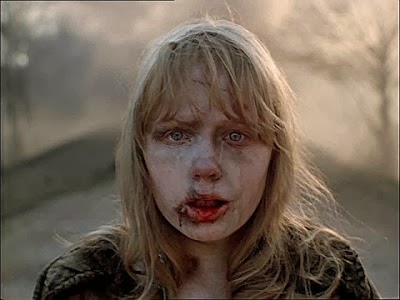
Images: Chagall's Over Vitebsk (at MoMA, acquired through the Lillie P. Bliss Bequest); still from Come and See

The childlike innocence of Chagall’s work is at odds with my imagined representation of the region of my mother’s tragic early childhood. My mother narrowly escaped one of more than 600 Belarusian villages burned to the ground. The only reference I have that even begins to depict what my mother saw is from the 1985 film Come and See.

In 1943, two Belarusian boys dig in a sand field in search of abandoned rifles. Young Flyora finds an SVT-40 rifle and the next day he joins partisans who come and take him from his house against his distraught mother’s wishes. Though members of my mother’s family and close friends were murdered and tortured by partisans, the critically acclaimed film’s central character offers insight into how innocence is quickly stolen, if not from a very different perspective.

A fan of gory horror films, I find few movies difficult to watch. I assumed this one was particularly painful since it depicts the real-life horror my mother experienced of watching a village and its inhabitants burned to the ground in a terrifying mass murder campaign.

“I understood that this would be a very brutal film and that it was unlikely that people would be able to watch it. I told this to my screenplay coauthor, the writer Ales Adamovich. But he replied: ‘Let them not watch it, then. This is something we must leave after us. As evidence of war, and as a plea for peace,’” said director Elem Klimov.

Klimov said ambulances had to be called to remove viewers from theaters in the Soviet Union and at foreign screenings. During a discussion after one viewing, an elderly German man acknowledged: "I was a soldier of the Wehrmacht; moreover, an officer of the Wehrmacht. I traveled through all of Poland and Belarus, finally reaching Ukraine. I will testify: everything that is told in this film is the truth. And the most frightening and shameful thing for me is that this film will be seen by my children and grandchildren.”

Klimov, who died in 2003, never made any films after Come and See. "I lost interest in making films,” he said in 2001. “Everything that was possible I felt I had already done."

Adamovich fought with the Belarussian partisans as a teenager, and Klimov was moved by a book I Am from the Burning Village, comprised of first-hand accounts of survivors like my mother. Innocent victims – especially young children -- are victims, despite their ethnic background or political inclination.

Klimov also watched footage of survivors recalling their experiences. “I will never forget the face and eyes of one peasant, and his quiet recollection about how his whole village had been herded into a church, and how just before they were about to be burned, an officer of the Sonderkommando gave them the offer: ‘Whoever has no children can leave.’ And he couldn't take it, he left, and left behind his wife and little kids... or about how another village was burned: the adults were all herded into a barn, but the children were left behind. And later, the drunk men surrounded them with sheepdogs and let the dogs tear the children to pieces.”

These second-hand accounts are like those of my mother, who tearfully recalls how so many loved ones were brutally killed.

“My aunt, at that time, was in school in Russia where they had to learn German. The German soldiers took her and another 16-year old, and they were asking who is living in this house and this house, and they had a list of people who they were told to burn down the houses. She was 16, so of course, she's going to say whose house it was. She was lucky because her father was also a Partisan, and of course he wasn't there at that time, but he was in their party. And my father was against the Bolsheviks and everything else, and he was in a German zone. And so when the Partisans came after them they told him whose house it was, they came to get my aunt, they wanted just her. My grandmother, she ran after her daughter. And then they would go and take them a few miles away from there, but they had to cross some kind of a river, and they were going to be interrogated there by the Partisans, where their headquarters were. But what happened, it became close to nighttime, and they had to get out of that region because I guess that's when the Germans were coming or something, so the Partisans said that we know what's going to happen with them, so they didn’t want to waste the bullets, I guess. And so they used the other part of the gun (rifle), the wooden part, and they beat their heads open. That's how they were killed, and when my father saw that, it really affected his mental state for the rest of his life. And so – [sobbing] then we had to just, I guess, put them in ground and we had to leave there because the fighting between the Germans and Russians would start.”

Most people truly begin to understand mortality and the human condition when their first parent or close relative dies.

For my mother, losing a peer was perhaps the most shattering glimpse into the frailty of life.

“I saw when the fighting was going on between the Germans and Russians -- I'm not sure if it was Partisans or the or the, Russian Army. I don’t know, I never asked my parents what army it was. But I know at that point I just saw the Germans afterwards because they're the ones that took us as prisoners after, so I really didn’t see any Russian soldiers after that. And there was a wagon full of stuff and we were walking on one side, and this other girl, about my age, was walking on the other side, and the grenade was thrown, and she was very close to me, and she got killed, and I didn’t. And of course there were other people that were killed but I remember her because she was a friend of mine, you know? And that was very, very tragic.”

While Belarus remains a deeply troubled nation, widely regarded as Europe's last dictatorship, modern-day Vitebsk Oblast is a thriving tourist destination known as Belaruskaye Paazerye, or land of the lakes, replete with rare plants and wildlife. The wasteland of my mother’s infancy now boasts an excellent infrastructure connecting it with commerce in bordering Russia, Ukraine, Poland, Lithuania and Latvia. Despite the political and social turmoil helmed in Minsk by (Vitebsk Oblast native) President Alexander Lukashenko, modern-day Vitebsk Oblast is closer to Chagall’s memory than my mother’s.  The region’s two major theaters, philharmonic society, 28 museums and the international Slavyanskiy Bazaar arts festival make it a cultural destination.

My mother’s only travel was to concentration, labor and displaced persons camps in Poland and Germany, while Chagall spent the bulk of his career in Russia, France and the U.S. Still the fragmented images of Vitebsk, “the soil that nourished the roots of my art,” in Chagall’s work disguise, but do not erase, the darkest multiple personalities of a homeland that always has been rife with strife.

Alexander Pushkin, who passed twice through Belarus: in May 1820, leaving for the southern exile; and in August 1824 on his way to exile from Odessa to the village of Mikhailovskoye, died before finishing a novel, Dubrovsky, inspired by a friend, a nobleman of Vitebsk Oblast.

Pushkin’s influence is found throughout Vitebsk, home to at least two monuments, a street, a public garden and a bridge named after the Russian poet. No doubt he contemplated the region’s conflicted character.

"The illusion which exalts us is dearer to us than ten thousand truths." (Pushkin, as quoted by Anton Chekhov in Gooseberries.)