Showing posts with label The Great Purge. Show all posts

Wednesday, March 26, 2014

Reliving Trauma by Mourning "Bad" Deaths


It was something like: “Ooooowhoawoahoooo!” The exact sound is impossible to convey in writing, but I can still hear it.

“Ooooowhoawoahoooo! Ooooowhoawoahoooo! Ooooowhoawoahoooo!”

My grandfather – my beloved Degushka -- the strong, stubborn, handsome, well-coiffed, impeccably attired, intimidating and often-argumentative man who I admired and idolized despite his prominent character flaws, was bellowing.

The chaotic chorus of “Ooooowhoawoahoooo!” was thunderous yet muffled. I called for him. In quickfire Russian, he warned me to hide, too. “They are coming! They have killed my sister and my mother! They will kill us all!”

Terrifying, but not delusional. His mother and sister were brutally murdered some seven decades ago in Belarus. Though on a quiet street in a Western Massachusetts suburb in the mid-1980s it would have struck any other passer-by as the ranting of madman, even though nobody else understood what he was saying.

As a tween and young teen, I volleyed between my parents’ house, about a mile-and-a-half away, and my grandparents' house. I forget why I was headed there, that day at that time. It was an otherwise mundane day that had gone -- by any middle-class suburban American standard existing at the time -- mad.

Deugshka was hiding under his car parked in the driveway, supine, legs straight, right arm crossed over left as if he were preparing to accept communion or his body readied for funeral and burial in the Russian Orthodox Church.

It was one of those moments. When I first learned the term posttraumatic stress disorder (PTSD) on the TV news, it referred to soldiers in the Vietnam War. As I came to understand it, I realized my grandfather was having a flashback, another term that had taken on a very different meaning in my social education. It wasn’t the first time I’d witnessed something like this, and certainly not the last. But feeling exposed on the driveway, even though nobody reacted, made me self-conscious. Already I was an outsider in this world of WASPs and other people who had no connection to the generation of their family that first arrived in America. Now this.

I was frustrated, scared and worst of all helpless. What could I possibly do? Get the keys and attempt to slowly roll back the car, hoping he didn’t budge? Attempt to drag him out? None of this was feasible. The episode, like all others, passed, but the impact was forever imprinted.

In the last years of her life, my Babushka, my mother’s mother, entered trancelike states where she would moan in a somber, steady stream of cries of and gasps for breath. The sound was similar to her husband’s “Ooooowhoawoahoooo!” but heavier and more sorrowful. In a PTSD flashback, she was mourning the deaths of her three young sons and countless close relatives and friends who died during my mother’s early childhood.

In all the years my maternal grandparents underwent tests for various medical conditions, not a single doctor ever mentioned PTSD.

With my mother, there also is no talk of PTSD, no mention of survivor's guilt or survivor's syndrome, which clearly is the root of her anxiety and stress related to what might otherwise be considered normal circumstances or situations. My mother feels guilty for surviving when her three brothers and peers perished. The Diagnostic and Statistical Manual of Mental Disorders, published by the American Psychiatric Association, removed survivor guilt as a specific diagnosis and redefined it as a significant symptom of PTSD. Regardless, my mother clearly suffers from both yet has never been treated for either.

So much of what is relived in these PTSD flashbacks manifests in concert with Russian Orthodox rituals and traditions and/or superstitions surrounding the complex mourning process.

Both the deliberate practices and the flashbacks play out like a dark fairytale. As a child I felt that the mourning in these PTSD episodes was a call back for the dead, as if somehow reliving the traumatic experience might reverse the outcome of the tragedy that claimed their lives.

In Russian folk tradition, death can be reversible and is related to sleep, a state in which one can experience the "other world" and return to tell about it. A couple of years after finding my Degushka bellowing under his car, I witnessed what my grandmother described as “crossing over” after a near-death experience. She called my parents’ house in the days of landlines, her voice muted and fading. I knew something was wrong. “Come quickly,” she said calmly. I stormed into the patio and ran into the house. The door was unlocked. She was nowhere. I rushed to the basement, where another time I found her laying in a pool of blood after she cracked her head in a tumble down the stairs. She was nowhere. I panicked. I ran back into the patio. She was laying on a sofa, still but faintly breathing, I think. In shock, I sat there, holding her hand. She awoke, describing how she’d walked through a green meadow and saw her mother, siblings, sons and others who told her “It’s not your time yet, Alexandra Dmitrieva.”

Russian folk tradition considers it a “good” death or “their own” when someone dies in old age surrounded by family, and a “bad” death or “not their own” when they die early, generally from murder, suicide, sickness or in war. My mother and her parents lost nearly every loved one to “bad” death during her early childhood at the hands of Stalin, The Nazis and the Belarusian Partisans. In Russian folklore, the soul is depicted as small and childlike, and sometimes as having wings and flying. It’s unsurprising that mother claims to have seen angels singing above her brother’s body during his funeral.

Tuesday, March 25, 2014

Flashback: The Trauma of Survival


"Miss Goo-rell?" the nurse called, tapping me on the shoulder as I circled the cramped family waiting room at Baystate Medical Center, focused on the surge of pain from tearing deep into my cuticle creating a little pool of blood, a practice I'd honed for coping with hospital-wait anxiety.

I jumped to face her. "It's Gur ..." I stopped myself from needlessly correcting her pronunciation.

"Yes, I'm Natasha Gural. Luba (LYU-bah) Gural’s daughter. Is my mother …”

The nurse looked at me strangely and carefully, as if my face had been replaced by a Magritte apple. This constant discomfort I feel in my birth city, where I over-analyze every action of people who choose to expend as little mental energy as possible to get by, particularly at this hospital, is compounded by fear of what she will say next.

“Your mother is fine, medically speaking. The procedure went well and she is awake,” despite what sounded like good news, her troubled expression intensified.

“OK … So can I see her?”

“Well, normally we do not let anyone into the recovery room immediately post-op, but she is calling for you. We don’t know what she is saying, but we think she is calling for you.”

“OK! She’s OK?”

“Yes, medically. But she is awake, and I suppose alert, but she seems to be in some kind of shock and she seems to be calling for you. We cannot understand how or why she is awake. She should be sleeping for hours …”

My mother’s hyper-sensitivity to sedatives and narcotics is bested only by her ability to remain awake on any dose, even as she experiences every other known side effect. I suspect it’s a defense mechanism.

I follow the nurse through giant doors clearly marked to fend off non-staff. I hear my mother. It sounds like a little girl, a voice I’d never heard, but one I’d imagined.

“Natashenka! Natashenka! Natashenka!” she half-cried-half-screamed as she alternated between English and Russian, both in that haunting childlike voice.

“I’m here, Mom,” I said, holding her hand.

“They are trying to kill me,” she said in what must have been an attempt at a whisper. “You have to get me out of here. Look: All the other people are dead! They are laying here dead!”

Every other patient was sound asleep on a cot, some young, some old, all attached to monitors and stuck with needles. All were expected to survive after a few hours following their operations, or else they’d have been whisked downstairs to ICU. But to my mother, the pale, motionless faces were corpses, on their last earthly journey from gurney to grave.

To the typical Baystate employee, my mother’s behavior was irrational, beyond their comprehension and control. That’s why they called in the expert: her daughter, the only one who might be able to perform where Valium conked out. Save for the odd orderly who experienced combat, nobody passing through those daunting doors could possibly understand how terror triumphed over IV-induced catatonia.

Though I had no means of calming her, I could at least empathize. Was I better off pretending she was correct and promising that I was going to get her out before they killed her, or should I try to draw her back to the start of the 21st century in the United States?

I knew exactly what she meant about the dead bodies destined for a mass grave. As a young child, I had recurring nightmares of a death camp where I, too, lay in limbo as others had already gone cold and rigid. In my dream, I made every effort to appear dead as guards in long, tailored coats and peaked caps, circled around my intended deathbed. My horrific visions originated from the stories my mother’s parents and other Great Purge and World War II civilian survivors shared in sharp detail, supplemented by my fascination with the dark side of my family’s history.

My nightmares were born from my mother’s real-life experience. I could only imagine how horrifying it was for her to relive that trauma, held captive in a cold, soulless depository of patients who were expected to lay lifelessly for a few hours offering the staff a respite from any interaction aside from gossiping about doctors, barking fried food orders to subordinates and creating a patient-less world through insufferable banal banter.

The nurse came by a few times, mainly to grumble that it’d be best if I could get my mother to sleep. “It’s the best thing you can do for her.” The countless shortcomings of the U.S. medical system are second only to its complete failure to recognize and identify the psychological needs of patients who were asked to fill out dozens of pages of paperwork, none inquiring into the unique background of a human being. There I was, the de-facto shrink-crisis manager-untrained Girl Friday left to deal with what the system isn’t willing to address.

If I sound bitter or resentful, it’s because I am. This is the same hospital where I was called upon to fill in where staff had failed, most notably when as a young teenager I was whisked from an ambulance that picked me up at school into an operating room and ICU with my mother’s father, translating orders on how he breathe during a lucid trauma procedure following as car crash “it’s a miracle he survived.” That nurse tapped me on the shoulder in the same room where I learned my father was dying from undiagnosed-despite-all-the-right-tests Stage IV colon cancer metastasized to the liver. This is the same hospital my grandfather once escaped before discharge. The same hospital where both my mother’s parents spent the cruelest of their dying days. I knew every hallway, every exit and every supply closet (since staff often don’t bother with the basic needs of patients who can no longer speak).

No wonder I was treated as unpaid personnel. Besides being called upon to assist with my own family member’s care, I’d once served as a translator in a language I barely claim proficiency when the emergency room supervisor said she couldn’t find a German translator for a Polish man who had apparently broken his leg. Before I came along, they’d suspected he’d suffered a heart attack.

Tuesday, February 25, 2014

Come and See the Magic and the Horror of Vitebsk Oblast


Marc Chagall called Vitebsk "my second Paris." For him the city neighboring his birth village Liozna is captured in memory that eludes the devastation of the Great Purge and World War II, as he spent those years in France and America. In a large series of works that the artist began after his return to his hometown in June 1914, Vitebsk is depicted as a fantastical dreamlike place.

The magical city of Chagall is radically different from where my mother was born and spent her first four or so years. Both my mother and Chagall were born in small villages outside of the city and bordering Russia, though she never visited the region’s capital.


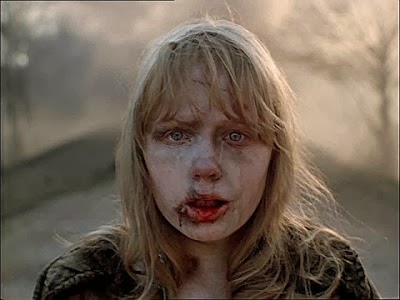
Images: Chagall's Over Vitebsk (at MoMA, acquired through the Lillie P. Bliss Bequest); still from Come and See

The childlike innocence of Chagall’s work is at odds with my imagined representation of the region of my mother’s tragic early childhood. My mother narrowly escaped one of more than 600 Belarusian villages burned to the ground. The only reference I have that even begins to depict what my mother saw is from the 1985 film Come and See.

In 1943, two Belarusian boys dig in a sand field in search of abandoned rifles. Young Flyora finds an SVT-40 rifle and the next day he joins partisans who come and take him from his house against his distraught mother’s wishes. Though members of my mother’s family and close friends were murdered and tortured by partisans, the critically acclaimed film’s central character offers insight into how innocence is quickly stolen, if not from a very different perspective.

A fan of gory horror films, I find few movies difficult to watch. I assumed this one was particularly painful since it depicts the real-life horror my mother experienced of watching a village and its inhabitants burned to the ground in a terrifying mass murder campaign.

“I understood that this would be a very brutal film and that it was unlikely that people would be able to watch it. I told this to my screenplay coauthor, the writer Ales Adamovich. But he replied: ‘Let them not watch it, then. This is something we must leave after us. As evidence of war, and as a plea for peace,’” said director Elem Klimov.

Klimov said ambulances had to be called to remove viewers from theaters in the Soviet Union and at foreign screenings. During a discussion after one viewing, an elderly German man acknowledged: "I was a soldier of the Wehrmacht; moreover, an officer of the Wehrmacht. I traveled through all of Poland and Belarus, finally reaching Ukraine. I will testify: everything that is told in this film is the truth. And the most frightening and shameful thing for me is that this film will be seen by my children and grandchildren.”

Klimov, who died in 2003, never made any films after Come and See. "I lost interest in making films,” he said in 2001. “Everything that was possible I felt I had already done."

Adamovich fought with the Belarussian partisans as a teenager, and Klimov was moved by a book I Am from the Burning Village, comprised of first-hand accounts of survivors like my mother. Innocent victims – especially young children -- are victims, despite their ethnic background or political inclination.

Klimov also watched footage of survivors recalling their experiences. “I will never forget the face and eyes of one peasant, and his quiet recollection about how his whole village had been herded into a church, and how just before they were about to be burned, an officer of the Sonderkommando gave them the offer: ‘Whoever has no children can leave.’ And he couldn't take it, he left, and left behind his wife and little kids... or about how another village was burned: the adults were all herded into a barn, but the children were left behind. And later, the drunk men surrounded them with sheepdogs and let the dogs tear the children to pieces.”

These second-hand accounts are like those of my mother, who tearfully recalls how so many loved ones were brutally killed.

“My aunt, at that time, was in school in Russia where they had to learn German. The German soldiers took her and another 16-year old, and they were asking who is living in this house and this house, and they had a list of people who they were told to burn down the houses. She was 16, so of course, she's going to say whose house it was. She was lucky because her father was also a Partisan, and of course he wasn't there at that time, but he was in their party. And my father was against the Bolsheviks and everything else, and he was in a German zone. And so when the Partisans came after them they told him whose house it was, they came to get my aunt, they wanted just her. My grandmother, she ran after her daughter. And then they would go and take them a few miles away from there, but they had to cross some kind of a river, and they were going to be interrogated there by the Partisans, where their headquarters were. But what happened, it became close to nighttime, and they had to get out of that region because I guess that's when the Germans were coming or something, so the Partisans said that we know what's going to happen with them, so they didn’t want to waste the bullets, I guess. And so they used the other part of the gun (rifle), the wooden part, and they beat their heads open. That's how they were killed, and when my father saw that, it really affected his mental state for the rest of his life. And so – [sobbing] then we had to just, I guess, put them in ground and we had to leave there because the fighting between the Germans and Russians would start.”

Most people truly begin to understand mortality and the human condition when their first parent or close relative dies.

For my mother, losing a peer was perhaps the most shattering glimpse into the frailty of life.

“I saw when the fighting was going on between the Germans and Russians -- I'm not sure if it was Partisans or the or the, Russian Army. I don’t know, I never asked my parents what army it was. But I know at that point I just saw the Germans afterwards because they're the ones that took us as prisoners after, so I really didn’t see any Russian soldiers after that. And there was a wagon full of stuff and we were walking on one side, and this other girl, about my age, was walking on the other side, and the grenade was thrown, and she was very close to me, and she got killed, and I didn’t. And of course there were other people that were killed but I remember her because she was a friend of mine, you know? And that was very, very tragic.”

While Belarus remains a deeply troubled nation, widely regarded as Europe's last dictatorship, modern-day Vitebsk Oblast is a thriving tourist destination known as Belaruskaye Paazerye, or land of the lakes, replete with rare plants and wildlife. The wasteland of my mother’s infancy now boasts an excellent infrastructure connecting it with commerce in bordering Russia, Ukraine, Poland, Lithuania and Latvia. Despite the political and social turmoil helmed in Minsk by (Vitebsk Oblast native) President Alexander Lukashenko, modern-day Vitebsk Oblast is closer to Chagall’s memory than my mother’s.  The region’s two major theaters, philharmonic society, 28 museums and the international Slavyanskiy Bazaar arts festival make it a cultural destination.

My mother’s only travel was to concentration, labor and displaced persons camps in Poland and Germany, while Chagall spent the bulk of his career in Russia, France and the U.S. Still the fragmented images of Vitebsk, “the soil that nourished the roots of my art,” in Chagall’s work disguise, but do not erase, the darkest multiple personalities of a homeland that always has been rife with strife.

Alexander Pushkin, who passed twice through Belarus: in May 1820, leaving for the southern exile; and in August 1824 on his way to exile from Odessa to the village of Mikhailovskoye, died before finishing a novel, Dubrovsky, inspired by a friend, a nobleman of Vitebsk Oblast.

Pushkin’s influence is found throughout Vitebsk, home to at least two monuments, a street, a public garden and a bridge named after the Russian poet. No doubt he contemplated the region’s conflicted character.

"The illusion which exalts us is dearer to us than ten thousand truths." (Pushkin, as quoted by Anton Chekhov in Gooseberries.)