Showing posts with label Alexander Pushkin. Show all posts

Thursday, April 10, 2014

Spirit of the Skaska

In a remote part of a sprawling land comprised largely of forest and home to more than 2,800 lakes and 500 rivers, a baby girl was born. The majority of those forests are centuries-old coniferous woods, which have survived horrible battles that have claimed countless human lives. The girl’s three brothers died as infants, along with friends and family, mostly innocent victims caught in the crossfire of multiple conflicts led by cruel and unrelenting conquerors. She watched and wept, not understanding why everyone was being killed, but also not knowing a life without such constant horrors. Her first years spent in this forest marred by bloodshed, bombs, grenades and murderous rampages, are forever imprinted in that girl’s memory, even as many details remain a blur of atrocities. So many tiny villages, so many large-scale attacks; it was impossible for those being forced from their homes even to know who was striking at any time or why.

Like a Russian skazka, or fairytale, my mother’s early years in small villages in Vitebsk Oblast in Belarus are fraught with horrific and otherworldly images that tell a dark story that many would like to bury.

Today some 1.2 million people live in Vitebsk Oblast, which borders Russia, Lithuania and Latvia. My mother, an ethnic Russian, was born close to the Russian border. The region now boasts excellent road infrastructure connected to several major international motorways, and international railway lines offering access to Russia, Ukraine, Poland and Lithuania. When my mother was born, the only path out for her and other survivors was through labor and concentration camps in Poland and finally a displaced persons camp in Germany. It was a war path, and even getting out alive left a legacy of pain and suffering that few could comprehend.

The modern day Vitebsk Oblast would likely be unrecognizable to my mother who has never returned to her homeland. The picturesque Belarusian land of lakes, or Belaruskaye Paazerye, inspires art and awes tourists who appreciate its natural beauty. This disputed land remains unsettled to this day. From my mother’s perspective it’s a mass grave, with no markings, just distant memories of where and when so many violently died or disappeared.

It’s easy to assume that Russians, or Slavs in general, are more dramatic, darker and heavier of heart than westerners. Imagine your entry into the world as a struggle to survive, and childhood realizations that you’d be better off dead with the rest than cope with the guilt of getting away alive. This lens obscures any hope of living a truly free life. Far worse than fear is the belief that if you’d perished someone else, someone you loved, would have thrived. Yet nobody thrives. Survivors of this kind of trauma, especially in early childhood, are forever living in debt, as if they owe it to those they watched die to live in some form of deprivation. They’re not deserving of any happiness, any quality of life, any peace. At least this is what I’ve learned from my mother, that little girl who never let her spirit blossom.

Regarded as a seminal figure in modern Russian literature, Alexander Pushkin also is significant for breathing new life into skazki, which exemplify the true native literature of a people and a history that have been cast into darkness. Sure there is levity and love and other conventions in lighter tales, but most are cautionary at best and the Slavic versions of classic European stories are handed down with a ponderousness in Russian. Mocking the woeful, soulful voice of the quintessential Russian is a western sport. But most westerners dismiss the root of this misery.

Alexander Afanasyev, a nineteenth century Russian folklorist who published a record 600-plus folktales and fairytales, is known both for depicting the archetypal figures found in universal stories in multiple languages, as well as recording uniquely Russian characters including Koshchey the Immortal (Bessmertny), Baba Yaga, the Swan Maiden and the Firebird.

While most westerners have read or heard some version of Baba Yaga, her male counterpart, Koshchey, tends to circulate more in Russian circles. He is an evil sorcerer who gallops on his magic steed, naked, around the Caucuses. I’d be surprised if Putin didn’t secretly regard him as a folk hero. A shape-shifter who takes on the form of windstorms, Koshchey steals away beautiful women, especially the brides of heroes. His presence is preceded by dark clouds, thunder and lightning. Think Loki, but much darker.  He is immortal (or “deathless,” which is a closer literal translation of bessmertny) because what he calls his death (but may be interpreted as his soul or spirit) is concealed and detached from his body. His death sometimes is hidden in a needlepoint inside a duck's egg, and Koshchey the Immortal may lose his powers and die if a hero finds the egg.

As with all folk tales, there are many versions of this story, and in Russian many words that could alter the meaning significantly. But this is a dark tale by any standard. I remember hearing it as a child and thinking it was perfectly plausible. After all, the tales of my mother, her parents and the few others who survived weren’t any less morose or ridiculous by the standards of where I was born.


Even my mother’s birthday has been passed down like a skaska, shrouded in mystery and blurred details. The first record of her birth was created by a priest when she was a schoolgirl at a displaced persons camp in Germany. As I attempt to retell what she remembers and what can be culled from the few remaining documents and photographs, I aim to keep the spirit of the skaska alive.

Tuesday, February 25, 2014

Come and See the Magic and the Horror of Vitebsk Oblast


Marc Chagall called Vitebsk "my second Paris." For him the city neighboring his birth village Liozna is captured in memory that eludes the devastation of the Great Purge and World War II, as he spent those years in France and America. In a large series of works that the artist began after his return to his hometown in June 1914, Vitebsk is depicted as a fantastical dreamlike place.

The magical city of Chagall is radically different from where my mother was born and spent her first four or so years. Both my mother and Chagall were born in small villages outside of the city and bordering Russia, though she never visited the region’s capital.


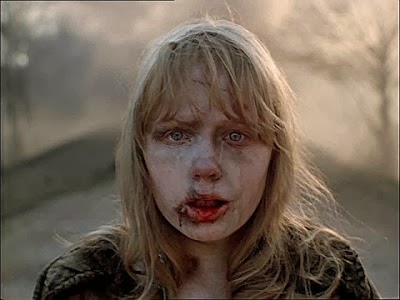
Images: Chagall's Over Vitebsk (at MoMA, acquired through the Lillie P. Bliss Bequest); still from Come and See

The childlike innocence of Chagall’s work is at odds with my imagined representation of the region of my mother’s tragic early childhood. My mother narrowly escaped one of more than 600 Belarusian villages burned to the ground. The only reference I have that even begins to depict what my mother saw is from the 1985 film Come and See.

In 1943, two Belarusian boys dig in a sand field in search of abandoned rifles. Young Flyora finds an SVT-40 rifle and the next day he joins partisans who come and take him from his house against his distraught mother’s wishes. Though members of my mother’s family and close friends were murdered and tortured by partisans, the critically acclaimed film’s central character offers insight into how innocence is quickly stolen, if not from a very different perspective.

A fan of gory horror films, I find few movies difficult to watch. I assumed this one was particularly painful since it depicts the real-life horror my mother experienced of watching a village and its inhabitants burned to the ground in a terrifying mass murder campaign.

“I understood that this would be a very brutal film and that it was unlikely that people would be able to watch it. I told this to my screenplay coauthor, the writer Ales Adamovich. But he replied: ‘Let them not watch it, then. This is something we must leave after us. As evidence of war, and as a plea for peace,’” said director Elem Klimov.

Klimov said ambulances had to be called to remove viewers from theaters in the Soviet Union and at foreign screenings. During a discussion after one viewing, an elderly German man acknowledged: "I was a soldier of the Wehrmacht; moreover, an officer of the Wehrmacht. I traveled through all of Poland and Belarus, finally reaching Ukraine. I will testify: everything that is told in this film is the truth. And the most frightening and shameful thing for me is that this film will be seen by my children and grandchildren.”

Klimov, who died in 2003, never made any films after Come and See. "I lost interest in making films,” he said in 2001. “Everything that was possible I felt I had already done."

Adamovich fought with the Belarussian partisans as a teenager, and Klimov was moved by a book I Am from the Burning Village, comprised of first-hand accounts of survivors like my mother. Innocent victims – especially young children -- are victims, despite their ethnic background or political inclination.

Klimov also watched footage of survivors recalling their experiences. “I will never forget the face and eyes of one peasant, and his quiet recollection about how his whole village had been herded into a church, and how just before they were about to be burned, an officer of the Sonderkommando gave them the offer: ‘Whoever has no children can leave.’ And he couldn't take it, he left, and left behind his wife and little kids... or about how another village was burned: the adults were all herded into a barn, but the children were left behind. And later, the drunk men surrounded them with sheepdogs and let the dogs tear the children to pieces.”

These second-hand accounts are like those of my mother, who tearfully recalls how so many loved ones were brutally killed.

“My aunt, at that time, was in school in Russia where they had to learn German. The German soldiers took her and another 16-year old, and they were asking who is living in this house and this house, and they had a list of people who they were told to burn down the houses. She was 16, so of course, she's going to say whose house it was. She was lucky because her father was also a Partisan, and of course he wasn't there at that time, but he was in their party. And my father was against the Bolsheviks and everything else, and he was in a German zone. And so when the Partisans came after them they told him whose house it was, they came to get my aunt, they wanted just her. My grandmother, she ran after her daughter. And then they would go and take them a few miles away from there, but they had to cross some kind of a river, and they were going to be interrogated there by the Partisans, where their headquarters were. But what happened, it became close to nighttime, and they had to get out of that region because I guess that's when the Germans were coming or something, so the Partisans said that we know what's going to happen with them, so they didn’t want to waste the bullets, I guess. And so they used the other part of the gun (rifle), the wooden part, and they beat their heads open. That's how they were killed, and when my father saw that, it really affected his mental state for the rest of his life. And so – [sobbing] then we had to just, I guess, put them in ground and we had to leave there because the fighting between the Germans and Russians would start.”

Most people truly begin to understand mortality and the human condition when their first parent or close relative dies.

For my mother, losing a peer was perhaps the most shattering glimpse into the frailty of life.

“I saw when the fighting was going on between the Germans and Russians -- I'm not sure if it was Partisans or the or the, Russian Army. I don’t know, I never asked my parents what army it was. But I know at that point I just saw the Germans afterwards because they're the ones that took us as prisoners after, so I really didn’t see any Russian soldiers after that. And there was a wagon full of stuff and we were walking on one side, and this other girl, about my age, was walking on the other side, and the grenade was thrown, and she was very close to me, and she got killed, and I didn’t. And of course there were other people that were killed but I remember her because she was a friend of mine, you know? And that was very, very tragic.”

While Belarus remains a deeply troubled nation, widely regarded as Europe's last dictatorship, modern-day Vitebsk Oblast is a thriving tourist destination known as Belaruskaye Paazerye, or land of the lakes, replete with rare plants and wildlife. The wasteland of my mother’s infancy now boasts an excellent infrastructure connecting it with commerce in bordering Russia, Ukraine, Poland, Lithuania and Latvia. Despite the political and social turmoil helmed in Minsk by (Vitebsk Oblast native) President Alexander Lukashenko, modern-day Vitebsk Oblast is closer to Chagall’s memory than my mother’s.  The region’s two major theaters, philharmonic society, 28 museums and the international Slavyanskiy Bazaar arts festival make it a cultural destination.

My mother’s only travel was to concentration, labor and displaced persons camps in Poland and Germany, while Chagall spent the bulk of his career in Russia, France and the U.S. Still the fragmented images of Vitebsk, “the soil that nourished the roots of my art,” in Chagall’s work disguise, but do not erase, the darkest multiple personalities of a homeland that always has been rife with strife.

Alexander Pushkin, who passed twice through Belarus: in May 1820, leaving for the southern exile; and in August 1824 on his way to exile from Odessa to the village of Mikhailovskoye, died before finishing a novel, Dubrovsky, inspired by a friend, a nobleman of Vitebsk Oblast.

Pushkin’s influence is found throughout Vitebsk, home to at least two monuments, a street, a public garden and a bridge named after the Russian poet. No doubt he contemplated the region’s conflicted character.

"The illusion which exalts us is dearer to us than ten thousand truths." (Pushkin, as quoted by Anton Chekhov in Gooseberries.)