Showing posts with label Alexander Lukashenko. Show all posts

Wednesday, April 23, 2014

A Primeval Forest of Guilt

A little girl lost in a forest, bewildered, in peril, not knowing when she’ll find a clearing. Such a quintessential and universal image would have been a fantasy for my mother, who watched the forests burn along with houses, as loved ones, friends and other children ran screaming usually to be greeted by death elsewhere. Survival seems like a way out. And for her there was an escape, but not to some idyllic land rich with frisky wildlife, ripe berries and fragrant flowers. Instead her path out, a forced one, was paved with the stench of death and not so much as a crumb to eat. The harsh environment wasn’t the worst of it. Losing others when she, for no good reason in her young perception, made it out alive came with a lifelong condition: guilt that ran deeper than the Dnieper River and stung more than a bullet wound.

Belarus was effectively flattened in World War II, leaving little of historic interest for tourists who flock to monuments and battle sites. But within those thick primeval forests and picturesque villages is buried a history of death and destruction.

Between 1937 and 1938, Stalin's NKVD secret police executed more than 1,000 people per day, most with a shot to the back of the head. As many as 1.6 million people were killed in Belarus during the Stalin-era purges, according to historian Ihar Kuznyatsow, even as officials claim only 600,000 Belarusians were killed. By any account, it’s a staggering number. Belarusian President Alexander Lukashenko has downplayed Stalin’s reign of terror, claiming that mass graves don’t contain the NKVD’s victims. For parts of modern-day Belarus, little has changed. The country still has Soviet-style collective farms and there has been very limited privatization.

To the best of her recollection, my mother was born June 21st or 23rd by the Gregorian calendar (now internationally the most widely used civil calendar) in either 1936 or 1938. As a Russian Orthodox Christian, my mother observes holy days, or moveable and immovable feasts, by the Julian calendar, a reform of the Roman calendar introduced by Julius Caesar in 46 BC. The Julian calendar served as the civil calendar in some countries until as late as the 20th century. But her birthday, for all practical intents and purposes, has been July 5th since she immigrated to the United States in 1950. It has nothing to do with the differences between the two calendars. “When my father was interrogated, when we were prisoners in Germany (circa 1946), he had made a mistake about (some other fact) and he got scared and that's what he gave as my date of birth,” she explains.

Whether she was born before or just as Stalin unleashed his murderous rampage is irrelevant because her earliest memories would be of a world ruled by this evil beast. As today’s evil dictator, Belarusian President Alexander Lukashenko (who was born in Vitebsk Oblast) continues to undermine the magnitude of the country’s losses, such historic events become mythical. Without any records of births and deaths and no markings on mass graves, it’s as if those who perished never existed outside the memory of survivors like my mother. Most of my mother’s close relatives, including all three of her brothers, and childhood friends were denied any burial ritual, all becoming lost in the very soil they identify with using a term zemlak (or zemlachka for women), literally meaning those from the same earth. For my mother’s parents, there was a culture to identify with before all the bloodshed. For my mother, there was nothing positive until she made it to a displaced persons’ camp in Germany.

My mother has no truly youthful memories. Her memories from youth don’t include any childlike whimsy that lends to the lighter side of fairytales. She didn’t learn many of these tales until she was older. As a little girl, these tales were passed down to me, both orally by my grandparents and their friends, many much older and from vastly different villages and cities, or in various tellings and translations. It’s unsurprising that my mother identifies only with the tales of the church, as her first happy memories are tied to hearing and singing liturgies.

Had my mother’s brothers lived, their story could have been more like the classic tale “The Metamorphosis Of The Dnieper, The Volga, And The Dvina,” of which the first and third run through Vitebsk Oblast.

The account recorded by 19th century Russian scholar and translator William Ralston Shedden-Ralston, a close friend of Ivan Turgenev, begins like this:

The Dnieper, Volga, and Dvina used once to be living people. The Dnieper was a boy, and the Volga and Dvina his sisters. While they were still in childhood they were left complete orphans, and, as they hadn’t a crust to eat, they were obliged to get their living by daily labor beyond their strength. “When was that?” Very long ago, say the old folks; beyond the memory even of our great-grandfathers.

Well, the children grew up, but they never had even the slightest bit of good luck. Every day, from morn till eve, it was always toil and toil, and all merely for the day’s subsistence. As for their clothing, it was just what God sent them! They sometimes found rags on the dust-heaps, and with these they managed to cover their bodies. The poor things had to endure cold and hunger. Life became a burden to them.

One day, after toiling hard afield, they sat down under a bush to eat their last morsel of bread. And when they had eaten it, they cried and sorrowed for a while, and considered and held counsel together as to how they might manage to live, and to have food and clothing, and, without toiling, to supply others with meat and drink. Well, this is what they resolved: to set out wandering about the wide world in search of good luck and a kindly welcome, and to look for and find out the best places in which they could turn into great rivers—for that was a possible thing then.


Depressing to most, this would have been a far brighter outcome for my mother’s siblings. For her, along with a childhood stolen, all hope is lost.

Tuesday, February 25, 2014

Come and See the Magic and the Horror of Vitebsk Oblast


Marc Chagall called Vitebsk "my second Paris." For him the city neighboring his birth village Liozna is captured in memory that eludes the devastation of the Great Purge and World War II, as he spent those years in France and America. In a large series of works that the artist began after his return to his hometown in June 1914, Vitebsk is depicted as a fantastical dreamlike place.

The magical city of Chagall is radically different from where my mother was born and spent her first four or so years. Both my mother and Chagall were born in small villages outside of the city and bordering Russia, though she never visited the region’s capital.


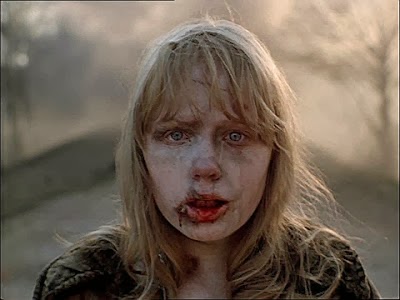
Images: Chagall's Over Vitebsk (at MoMA, acquired through the Lillie P. Bliss Bequest); still from Come and See

The childlike innocence of Chagall’s work is at odds with my imagined representation of the region of my mother’s tragic early childhood. My mother narrowly escaped one of more than 600 Belarusian villages burned to the ground. The only reference I have that even begins to depict what my mother saw is from the 1985 film Come and See.

In 1943, two Belarusian boys dig in a sand field in search of abandoned rifles. Young Flyora finds an SVT-40 rifle and the next day he joins partisans who come and take him from his house against his distraught mother’s wishes. Though members of my mother’s family and close friends were murdered and tortured by partisans, the critically acclaimed film’s central character offers insight into how innocence is quickly stolen, if not from a very different perspective.

A fan of gory horror films, I find few movies difficult to watch. I assumed this one was particularly painful since it depicts the real-life horror my mother experienced of watching a village and its inhabitants burned to the ground in a terrifying mass murder campaign.

“I understood that this would be a very brutal film and that it was unlikely that people would be able to watch it. I told this to my screenplay coauthor, the writer Ales Adamovich. But he replied: ‘Let them not watch it, then. This is something we must leave after us. As evidence of war, and as a plea for peace,’” said director Elem Klimov.

Klimov said ambulances had to be called to remove viewers from theaters in the Soviet Union and at foreign screenings. During a discussion after one viewing, an elderly German man acknowledged: "I was a soldier of the Wehrmacht; moreover, an officer of the Wehrmacht. I traveled through all of Poland and Belarus, finally reaching Ukraine. I will testify: everything that is told in this film is the truth. And the most frightening and shameful thing for me is that this film will be seen by my children and grandchildren.”

Klimov, who died in 2003, never made any films after Come and See. "I lost interest in making films,” he said in 2001. “Everything that was possible I felt I had already done."

Adamovich fought with the Belarussian partisans as a teenager, and Klimov was moved by a book I Am from the Burning Village, comprised of first-hand accounts of survivors like my mother. Innocent victims – especially young children -- are victims, despite their ethnic background or political inclination.

Klimov also watched footage of survivors recalling their experiences. “I will never forget the face and eyes of one peasant, and his quiet recollection about how his whole village had been herded into a church, and how just before they were about to be burned, an officer of the Sonderkommando gave them the offer: ‘Whoever has no children can leave.’ And he couldn't take it, he left, and left behind his wife and little kids... or about how another village was burned: the adults were all herded into a barn, but the children were left behind. And later, the drunk men surrounded them with sheepdogs and let the dogs tear the children to pieces.”

These second-hand accounts are like those of my mother, who tearfully recalls how so many loved ones were brutally killed.

“My aunt, at that time, was in school in Russia where they had to learn German. The German soldiers took her and another 16-year old, and they were asking who is living in this house and this house, and they had a list of people who they were told to burn down the houses. She was 16, so of course, she's going to say whose house it was. She was lucky because her father was also a Partisan, and of course he wasn't there at that time, but he was in their party. And my father was against the Bolsheviks and everything else, and he was in a German zone. And so when the Partisans came after them they told him whose house it was, they came to get my aunt, they wanted just her. My grandmother, she ran after her daughter. And then they would go and take them a few miles away from there, but they had to cross some kind of a river, and they were going to be interrogated there by the Partisans, where their headquarters were. But what happened, it became close to nighttime, and they had to get out of that region because I guess that's when the Germans were coming or something, so the Partisans said that we know what's going to happen with them, so they didn’t want to waste the bullets, I guess. And so they used the other part of the gun (rifle), the wooden part, and they beat their heads open. That's how they were killed, and when my father saw that, it really affected his mental state for the rest of his life. And so – [sobbing] then we had to just, I guess, put them in ground and we had to leave there because the fighting between the Germans and Russians would start.”

Most people truly begin to understand mortality and the human condition when their first parent or close relative dies.

For my mother, losing a peer was perhaps the most shattering glimpse into the frailty of life.

“I saw when the fighting was going on between the Germans and Russians -- I'm not sure if it was Partisans or the or the, Russian Army. I don’t know, I never asked my parents what army it was. But I know at that point I just saw the Germans afterwards because they're the ones that took us as prisoners after, so I really didn’t see any Russian soldiers after that. And there was a wagon full of stuff and we were walking on one side, and this other girl, about my age, was walking on the other side, and the grenade was thrown, and she was very close to me, and she got killed, and I didn’t. And of course there were other people that were killed but I remember her because she was a friend of mine, you know? And that was very, very tragic.”

While Belarus remains a deeply troubled nation, widely regarded as Europe's last dictatorship, modern-day Vitebsk Oblast is a thriving tourist destination known as Belaruskaye Paazerye, or land of the lakes, replete with rare plants and wildlife. The wasteland of my mother’s infancy now boasts an excellent infrastructure connecting it with commerce in bordering Russia, Ukraine, Poland, Lithuania and Latvia. Despite the political and social turmoil helmed in Minsk by (Vitebsk Oblast native) President Alexander Lukashenko, modern-day Vitebsk Oblast is closer to Chagall’s memory than my mother’s.  The region’s two major theaters, philharmonic society, 28 museums and the international Slavyanskiy Bazaar arts festival make it a cultural destination.

My mother’s only travel was to concentration, labor and displaced persons camps in Poland and Germany, while Chagall spent the bulk of his career in Russia, France and the U.S. Still the fragmented images of Vitebsk, “the soil that nourished the roots of my art,” in Chagall’s work disguise, but do not erase, the darkest multiple personalities of a homeland that always has been rife with strife.

Alexander Pushkin, who passed twice through Belarus: in May 1820, leaving for the southern exile; and in August 1824 on his way to exile from Odessa to the village of Mikhailovskoye, died before finishing a novel, Dubrovsky, inspired by a friend, a nobleman of Vitebsk Oblast.

Pushkin’s influence is found throughout Vitebsk, home to at least two monuments, a street, a public garden and a bridge named after the Russian poet. No doubt he contemplated the region’s conflicted character.

"The illusion which exalts us is dearer to us than ten thousand truths." (Pushkin, as quoted by Anton Chekhov in Gooseberries.)

Monday, December 9, 2013

On Being (Bela)Rus(s)ian


I’ve been struggling to figure out the story behind the photos I posted of my grandfather and his father holding numbers. Online research is useless, and none of the dozens of professors and other experts of Slavic studies and history I reached out to have any clue. The replies, at least have been cordial, save for one from a non-academic that raised an irrelevant point that plays into something I’ve been meaning to write about.

“Those men on them (the photos) do not look like Belarusian types very much,” said the would-be source, a journalist who covers Belarus and other countries for a global news organization. 


His reply, for a number of reasons, offended me. As I attempt to let go of my toxic emotional response, I recall so many random and unrelated comments that have rattled my own cultural identity.

Just four days before receiving this journalist’s email, my son Michael Alexander, who is half Italian-American, and I were at a Japanese restaurant in Dumbo where we have lunch every Monday after school and before his art class.  It was packed that day, so we sat at the sushi bar. As Michael Alexander grabbed and devoured a piece of white tuna from my plate, the sushi chef smiled and said: “Russian boys are good and strong because they like fish.” He looked shocked when I told him we both were born in the U.S., insisting that “you both look very Russian.” His observation was meant as a compliment, applauding me for “teaching him right, even in America.”

Dozens of times I’ve been approached by people, usually blonde women around my mother’s age, who speak to me in Russian, asking for subway or walking directions. They’re all surprised when I tell them, in Russian, that I was born here. When I first moved to New York and was apartment hunting, the longtime Ukrainian landlords in the East Village called me only Natali, the Ukrainian diminutive for Natalia. (Natasha is my legal name, but I was baptized Natalia.) They’d assure me “you don’t look Russian at all. You look only Ukrainian.” Meantime, the well-heeled Russian-born brokers wanted me to move to the Upper East Side, insisting that’s “where all the Russians are. Don’t worry, you do not look Ukrainian or Polish at all, just Russian.” I won’t even get into what all of them say when I mention my mother was born in Belarus.

I joke that I was born to hate myself, the embodiment of Slavic ethnic strife. My father was born in the U.S. to a Polish mother and a Ukrainian father.

Few non-Slavs even knew what a Belarusian or a Ukrainian was throughout my early childhood. I recall few things from what I considered to be a lousy “world cultures” class in 7th or 8th grade at a private girls’ school in 1980s Massachusetts. I hold a grudge to this day and blame the teacher for perpetuating myths about cultures he apparently hadn’t studied beyond the simplistic and poorly written textbook we used. “All Russians look like this,” he told the class pointing to a photograph of a young girl with dark hair and dark eyes. I stayed after class to tell him that there isn’t an archetypal look that is Russian, since the world’s biggest country is home to some 160 cultures and very few, if any, inhabitants can trace their heritage to just one. He laughed and patted me on the back, but said nothing other than “you’d better not be late for your next class.” I’d risked a “red dot” for being late for my next class, but the other teacher wasn’t the petty type who made such threats and enforced Soviet-inspired punishment. My grade in his class slipped slowly after that, even if my test scores never dropped.

Naturally there is more to being Russian or Belarusian or Ukrainian or Polish, or a mix of those and likely other ethnicities, than appearance. Escalating national and ethnic tensions are making headlines now, after protesters in Ukraine's capital Kiev knocked down a statue of Vladimir Lenin on Sunday. But Belarus is an even stranger place with far more strife and instability that’s fueled by corruption and its repeated role in war after lengthy and gory war.

My grandfather may have interpreted the journalist’s comment that “Those men …  do not look like Belarusian types very much” very differently as he identified himself as a Russian, not a Belarusian. As I’ve mentioned, he, my grandmother and my mother all were born in Belarus, just over the Russian border. That they were persecuted and that many family members and close friends were killed by Belarusian nationalists, is clearly part of the staunch Russian pride.

It is challenging for me when people attempt to claim me as their own, based on ethnicity as well as religion and cultural heritage. Living in New York, I hear “you’re Jewish like me, right?” as much as “you look Russian, “ or “you look Ukrainian” or “you look “Polish.”

I grapple with what all this means, as it pertains to my mother’s history.

Even a cursory scan of the history of Belarus should quickly dismiss any claim to a pure ethnic identity or “look.”

Stone Age settlements have been discovered in the Gomel region, with sites from the Palaeolithic period unearthed in the village of Yurovichi (Kalinkovichi area) dating back some 26,000 years. Bronze Age artifacts have been found throughout Belarus and at the start of the Iron Age there were three main settlements in Belarus around the basins of the Dneiper, Dvina and Pripyat rivers.

Colonization by the Slavs began in the early centuries AD, eventually replacing the Baltic culture. East Slavs formed the first political associations, or unions of tribes, in the 6th and 9th centuries. The first records from the Polotsk Duchy in what is now modern Vitebsk Oblast and the northern part of the Minsk Oblast date back to the 9th century. Polotsk dominated until the 13th century when the Grand Duchy of Lithuania, Rus and Samogotia – which spanned modern Belarus, Lithuania, the Kiev, Chernigov and Volyn areas of the Ukraine and western Russia from the Baltics to the Black Sea – rose to power in the 13th century and only began to crumble after multiple wars in the 16th century.

In 1569 the Grand Duchy and the Kingdom of Poland signed the Union of Lublin to create Rzeczpospolita (the traditional Polish State). This ushered in a period of turmoil, which included a war with Russia (1654-1667) and the North War with Sweden and Russia (1700-1721). Battered by its rivals, Rzeczpospolita eventually lost and in 1772 the western provinces of Belarus were annexed to the Russian Empire. In 1795 Rzeczpospolita was divided between Russia, Austria and Prussia.

Under the first Russification efforts, what was Belarus became a place of ongoing conflict and confusion with revolt under Tadeusz Kostushko’s leadership (1794), the Napoleonic invasion of Russia (1812), the Polish Revolt (1830–1831) and the Great Rebellion, headed by Kastus Kalinovski (1863-1864). During this period, Belarusian students in Saint Petersburg began organizing what set the foundation for the first Belarusian national political party formed in 1903. The Stolypin agrarian reforms, a series of changes to Imperial Russia's agricultural sector launched in 1906, resulted in mass displacement of the peasant classes until 1914, including 33,000 people who were moved from Belarusian territory to Siberia.

During World War I, German and Russian forces fought bloody battles on Belarusian territory, until March 3, 1918, with the signing of the Treaty of Brest-Litovsk. Then came the Russian Revolution and the Belarusian People’s Republic declared independence in March 1918, which lasted until the German withdrawal at the end of the year. The Belarusian Soviet Socialist Republic was created Jan. 1, 1919.

After the Russo-Polish War (1919-1921), the Riga Peace Treaty resulted in the partitioning of Belarus between the Belarusian Soviet Socialist Republic and Poland. All of Belarus was under the New Economic Policy (NEP), implemented by the government of the Soviet Union from 1921 to 1928 and representing a temporary retreat from its previous policy of extreme centralization and doctrinaire socialism. Meantime, the Polish part of Belarus was subjected to Polonization from 1921-1930s. In 1922, the Belarusian SSR became a part of the Union of the Soviet Socialist Republics (USSR).

It only got worse ahead of my mother’s birth. Soviet economic policy and the introduction of collective farming caused famine in Belarus from 1932-1933. During the Great Purge (1936-1940) more than 86,000 Belarusians suffered political oppression and more than 28,000 were sentenced to death. (My mother was born in 1936 or 1938.)

The Red Army moved into West Belarus on Sept. 17, 1939, two weeks after World War II started. In June 1941, the Great Patriotic War began and by September Belarus was fully occupied by the German army. By the end of 1941, the Belarusian Partisans surfaced and ballooned into the biggest movement in Europe before 1944.

Little has changed, at least in terms of attitude and perception.

A new analytical paper "Belarusian Identity: The Impact of Lukashenka's Rule" released today by the Centre for Transition Studies suggests that President Alexander Lukashenko rejected the ethno-national model of state suggested by his predecessors in the early 1990s and restored a Soviet style “statist nation” run by a centralized bureaucracy. After being elected in 1994, Lukashenko launched a policy of Russification, selecting Russia as a strategic priority for foreign relations in a supposed effort to recover from the economic crisis. A year later he initiated a referendum to introduce Russian as a second official language in Belarus, with the vast majority, or 83.3%, of voters supporting the initiative. The Constitution of Belarus declares the equal status of both languages, but Russian dominates all facets of life and public organizations and officials generally speak Russian.

Since the early noughts, all major Belarus-based media broadcasts are aired in Russian, and there are no all-Belarusian language universities. The study data shows the even as more residents identify themselves as Belarusians, the use of the Belarusian language has eroded, and a Russian-speaking Belarusian nation has emerged. When asked “What unites you with other people of your nationality?” Belarusians refer more to territory and state, than to culture and language. The majority consider the origin of Belarusian statehood in mediaeval Polack and Turaŭ princedoms and the Great Duchy of Lithuania, not in the Belarusian SSR. Still the same people have embraced symbols, such as national holidays and the red-green flag, introduced by Lukashenko’s regime.

“The Belarusian nation, unlike most European nations, did not emerge along ethno-national lines, with an indigenous language, culture or a solid nationalist historical narrative. Rather, it consolidated as a result of a Communist experiment which lasted for 70 years. It experienced many of the major disasters of the 20th century, including both the Stalinist terror and the horrors of World War II. This turbulent path has impacted Belarusians profoundly and, after 20 years of independence, the Belarusian nation is still trying to find its way,” wrote the paper’s author, Vadzim Smok, a researcher at the Institute of Political Studies 'Political Sphere' based in Minsk and Vilnius.

Smok looks to people like my cousin Tanya, who just began teaching after graduating from Minsk State Linguistic University (MSLU) to effect dramatic social change.

“Younger generations will play a crucial role in the future development of the Belarusian nation. They communicate by the Internet, which remains a free and open space for communication and exchange of ideas in Belarus. They did not undergo Soviet indoctrination or experience its relentless propaganda and tend to prefer to work in the private sector, meaning they are less and less tied to the state. These people look much more free and democratically minded then their parents, and quite soon they will rule the country,” Smok concluded.

For now, I’m still entangled in what my mother’s birthplace means for my family’s identity. Do I have a Belarusian “look”? Do I care? Apparently I do.

My Marvel Avengers’ obsessed (his father’s student) son, the one who was mistaken for a “boy from Russia,” had wanted to be Spider-Man this past Halloween but I insisted he also try on a Thor costume. The saleswomen swooned, with two singing in unison “He IS Thor!” Perhaps that means that he has the “Bealrusian look,” which could be more Old Norse than anything else. In 2010, archaeologists found the remains of an ancient Viking (or what East Slavs call Varangian) settlement in Vitebsk Oblast, where my mother and her parents were born. 

                                                   (Photo credit: Dave Stewart Photogrpahy)


Said Marc Chagall, the Vitebsk-born artist with an extremely complicated ethno-cultural identity, “The soil that nourished the roots of my art was Vitebsk."